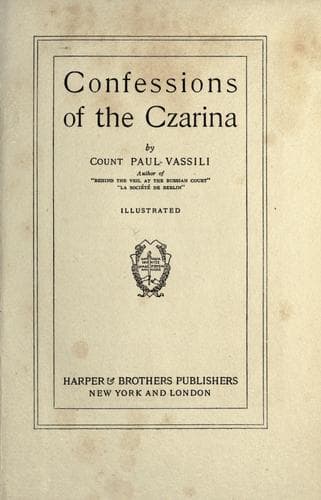
Confessions of the CzarinaRadziwill, Catherine, Princess
History
Confessions of the Czarina
Radziwill, Catherine, Princess
Alexandra, Empress, consort of Nicholas II, Emperor of Russia, 1872-1918; Russia -- Court and courtiers
Never was its truth more forcibly illustrated than in the tragedy which
brought about the fall of the autocratic system of government under
which Russia had been suffering for centuries. Its last representative
had incarnated in his person all the follies, the crimes, the mistakes,
and the ruthless cruelty of his predecessors. Unlike them, he had not
known how to temper them by personal authority or personal sympathy. He
was an effeminate, degenerate descendant of strong ancestors; the whole
atavism of a doomed race seemed to have become embodied in his weak
individuality. If outside catastrophes had not occurred in his reign, it
is still likely that he would have been compelled by a revolution of
some kind or other to step back into an obscurity out of which he ought
never to have emerged, because he was most certainly not able to bear
the rays of the “fierce light which beats upon a throne.” It is,
however, possible that none of those supreme calamities which destroy
the independence and self-respect of nations as well as of individuals
would have been connected with his name and history. But destiny
condemned him to remain forever, in the annals of the world, a living
proof of the degeneracy which threatens all royal houses who do not
possess sufficient energy to stand in perfect union with their people
whenever a trial of some kind comes to threaten their mutual existence.
It would have been hard enough to be branded by the centuries to come as
the last of the Romanoffs and as an unworthy Heir of Peter the Great. It
was worse than hard for Russia, even more than for Nicholas II., to have
to realize that, through stupidity, weakness of character, and an
exaggerated opinion of his own power and might, he had been the direct
cause of the ruin of his country and the means of plunging it into an
abyss of distress and of anarchy from which it will take the work of
several generations to redeem it.
His wife was the instrument of his destruction. About this last point
there cannot exist any doubt whatever. She had a character stronger than
his and she could speak to him in the name of the son to whom they were
both so completely devoted. She could also appeal to his religious and
superstitious feelings, which, though not as exaggerated as her own and
not quite so foolishly carried to extremes, were yet also devoid of
sound common sense. They were connected with the conviction that he had
a mission to perform in regard to the future of his subjects, and to
their welfare both in this world and in the next. Nicholas II. had in
his character something of the traits of Caligula and other Roman
emperors--a mixture of cruelty and theatrical sentimentality combined
with cowardice in presence of danger and indecision before immediate
peril. He never knew what it meant to play the game, and he perished
because he refused to fight it out on the day that he discovered his
adversary held all the trumps.
Public-domain text, read in full here on John Shaqi.
Reviews
Reviews
No reviews yet
Be the first to share your thoughts on this work.
Elsewhere in the archive
Join the Discussion
Join the discussion
Sign in to leave a comment or review.
Sign InorCreate an account