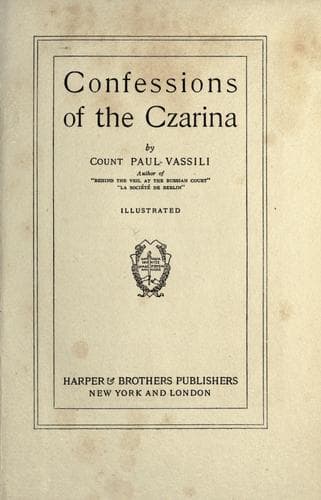
Confessions of the CzarinaRadziwill, Catherine, Princess
History
Confessions of the Czarina
Radziwill, Catherine, Princess
Alexandra, Empress, consort of Nicholas II, Emperor of Russia, 1872-1918; Russia -- Court and courtiers
In the mean while the war was going on, claiming every day new victims.
The insufficiency of the Government to face its various problems became
more patent. Instead of applying himself to the task of coping with
them, the Czar became absorbed, thanks to the remonstrances of his wife,
in the one thought of how to consolidate his own authority, reduce to
silence the protestations of the country and those of its
representatives in the Duma, and conclude a peace with Germany which
would allow him to make an appeal to his troops to help him to crush
once more the Revolution which was hammering at his door, which he
imagined he could subdue as easily as he had annihilated the one that
had broken out after the Japanese campaign.
These were splendid plans indeed, and the Empress was already rejoicing
at their success, in ignorance of the revolt which was shaking public
opinion out of its previous apathy, a revolt which had extended itself
to her own family. Bad as were most of the Grand Dukes, dissolute as
their conduct had ever been, yet they had in their veins the blood of
Catherine the Great and of all the dead and gone Romanoffs. They rose in
rebellion against the gang of adventurers who were dishonoring the chief
of their race and of their dynasty.
By that time the name of the Empress was being dragged in the dirt
by every street boy, and open comments were made in public places
in regard to her friendship, not to call it by another name, for
Raspoutine--comments which were devoid of truth, because there was never
any immorality in their relations, but which were generally believed,
perhaps, because it would have been impossible for any one to guess that
it was through superstitious practices that the “Prophet” had contrived
to get absolute hold of her mind.
The Imperial Family felt the degradation to which this common peasant
had reduced it, and though they had no reason in the world to like
Nicholas II., yet they resented the humiliation which any slur upon the
reputation of his wife conferred upon him as well. After all, Alexandra
Feodorowna was the mother of the future Czar, and as such she ought to
inspire respect in the Russian nation. If she did not realize this fact
herself, others had to do it for her and rid her of a contact which was
a slur. Besides, there was the hope that if once the adventurer was
removed she could be brought to look upon the world from a more
reasonable point of view. The principal thing was to deliver her from
this evil adviser who was fast leading her, as well as the dynasty, to
inevitable destruction and ruin.
Public-domain text, read in full here on John Shaqi.
Reviews
Reviews
No reviews yet
Be the first to share your thoughts on this work.
Elsewhere in the archive
Join the Discussion
Join the discussion
Sign in to leave a comment or review.
Sign InorCreate an account