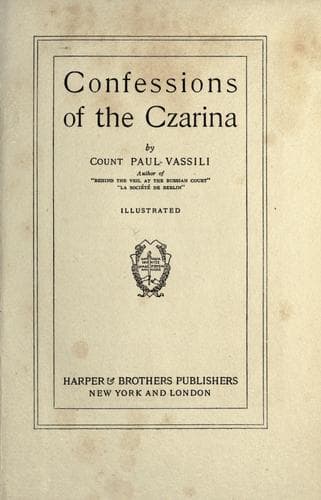
Confessions of the CzarinaRadziwill, Catherine, Princess
History
Confessions of the Czarina
Radziwill, Catherine, Princess
Alexandra, Empress, consort of Nicholas II, Emperor of Russia, 1872-1918; Russia -- Court and courtiers
And yet public feeling was so strong against her, and so entirely in
favor of those who had had the courage to rid Russia of a man who had
proved so fatal to it, that the schemes of revenge of Alexandra
Feodorowna suffered a collapse. Mighty and powerful as Nicholas II.
believed himself to be, yet he understood that the best thing he could
do would be to let silence and oblivion fall over a crime that was
eminently popular in the whole country. He had heard of the telegrams of
congratulation, and of the flowers which had been sent to both his
cousin Dmitry Pawlowitch and to the husband of his niece, young Prince
Youssoupoff, as well as the joy to which the population of Petrograd had
given way when it had become aware of the fate of the adventurer whose
name had been so prominently and so sadly associated with that of the
Empress of All the Russias. Perhaps at heart he was not so very sorry at
an event which had certainly rid him of a great incumbrance.
Nicholas II. had always practised dissimulation to a considerable
extent, and he had never allowed outsiders to guess what was going on in
his mind. During the days which followed upon the disappearance of
Raspoutine he certainly expressed great sympathy for the grief of his
wife, but at the same time he did not, as she expected, cause the
perpetrators of the murder of this low adventurer to be prosecuted
publicly for their daring action. This apathy exasperated Alexandra
Feodorowna.
During the last weeks of Raspoutine’s life he had been working,
conjointly with Sturmer and Protopopoff, toward convincing her to lend
herself to a Palace revolution which would have overturned her husband
and made little Alexis Czar under her own Regency. She had been told
over and over again that she possessed all the great talents of
Catherine II., that the Emperor was not a better man than Peter III. She
had been made acquainted with his unpopularity, but at the same time
persuaded that this unpopularity was a purely personal thing and that it
did not extend itself to the person of the Heir to the Throne, nor even
to her own. As Regent she could do any amount of good, and conclude
peace with Germany the more easily that she was not bound by the terms
of the agreement entered into by Mr. Sazonoff with the Entente, in the
name of Nicholas II.
Public-domain text, read in full here on John Shaqi.
Reviews
Reviews
No reviews yet
Be the first to share your thoughts on this work.
Elsewhere in the archive
Join the Discussion
Join the discussion
Sign in to leave a comment or review.
Sign InorCreate an account