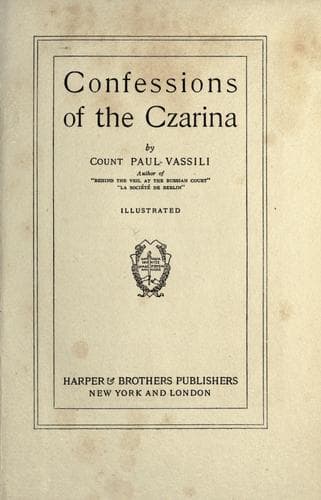
Confessions of the CzarinaRadziwill, Catherine, Princess
History
Confessions of the Czarina
Radziwill, Catherine, Princess
Alexandra, Empress, consort of Nicholas II, Emperor of Russia, 1872-1918; Russia -- Court and courtiers
The story of Raspoutine’s assassination is too well known to be repeated
here. At any time it would have broken the heart of the poor, misguided
Czarina. But coming at the moment it took place, it did something
more--it deprived her of what she considered to be her only moral
support amid the troubles of her life, the possibility of communicating
with the spirit of the man whom she had loved, who she felt sure was
watching over her and over her child, from the heavens.
In the weeks preceding the murder of the “Prophet” he had subjected the
Empress almost every evening to the agony of these prayer-meetings
during which he communicated to her the so-called wishes of her dead
friend, who, as he said, advised her, through his medium, as to what
she ought to do to avert the dangers which were hovering over her head.
The miserable woman used to listen to these revelations with anxious
eagerness, and pray, pray, with a fervor she had never known before, for
the strength to obey the commandments of a spirit who in death, as well
as in life, had proved to be her best, and indeed her only, friend. Is
it a wonder that the last remnants of sanity which were still left to
her snapped under this terrible strain, and that at last she became the
mere shadow of her former self, a fit subject for a lunatic asylum,
where, indeed, she ought, for the good of everybody, to have been
confined?
Her conduct after she had been told of the murder of the creature whom
she revered as a Prophet of God was quite in accord with her character,
such as it had developed itself through all the years during which she
had allowed her mind to be invaded with superstitious notions, which
would have been laughable if they had not been so pathetic. Her only
thought was that of vengeance. She exercised it with a relentlessness
which set against her the few people left in Petrograd who might have
felt inclined to take her part and to pity her in this tragedy of her
life. She left no peace for the Czar until he had exiled the persons
whom she knew to have been the authors of the deed. When she was
implored to take pity on the young Grand-Duke Dmitry, and not have him
sent to the Persian front, where there existed so many epidemics that it
was hardly likely he would ever come back again, she had merely smiled
and coldly said:
“Why should I pity him? He did not pity others.”
Public-domain text, read in full here on John Shaqi.
Reviews
Reviews
No reviews yet
Be the first to share your thoughts on this work.
Elsewhere in the archive
Join the Discussion
Join the discussion
Sign in to leave a comment or review.
Sign InorCreate an account