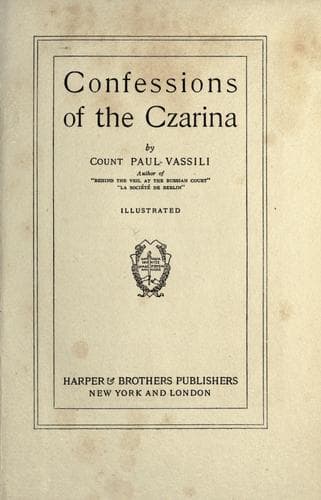
Confessions of the CzarinaRadziwill, Catherine, Princess
History
Confessions of the Czarina
Radziwill, Catherine, Princess
Alexandra, Empress, consort of Nicholas II, Emperor of Russia, 1872-1918; Russia -- Court and courtiers
The Cabinet saw this hesitation, and would undoubtedly have struck a
serious blow at its adversaries if, just at the time, the children of
the Empress had not sickened from the measles in a serious form. The
mother forgot all her political intrigues in her anxiety; the plot about
to be executed had perforce to be put off until a more favorable day. It
must be here remarked that the Czar, when he heard about his son’s and
daughters’ illness, telegraphed to his wife asking her whether she
wished him to come back to Tsarskoye Selo. This did not suit in the
least the people who were only waiting for a favorable opportunity to
dethrone their Sovereign. Alexandra Feodorowna was easily persuaded to
oppose herself to this desire of her husband and to wire back to him not
to return. By a singular coincidence the presence of Nicholas II. at
Tsarskoye Selo, which would without doubt have given quite another
coloring to events which were going to happen within a few days, was
desired neither by his friends nor by his foes nor even by his family.
They all of them knew that something terrible was about to take place,
but they also felt that, for the sake of everybody, it would be better
he should be absent.
And in the silence of his study at Potsdam the Kaiser was secretly
discounting this Russian Revolution which he saw quite clearly was
approaching with quickening strides. He knew what he was about, and
little did it matter to him if those whom he had used as pawns in the
difficult game he had been playing would perish or not in the storm
which his efforts had contributed to let loose.
XXV
THE NATION WANTS YOUR HEAD
I feel personally sure--and others who were in Petrograd at the time of
the fall of the Romanoffs told me the same thing--that in this whole
history of the overthrow of one of the most formidable powers the world
had ever known there are yet details which we do not know. In fact, no
one knows them, but perhaps they will be explained to us later on. The
catastrophe occurred with such startling rapidity that even those who
were the most concerned in it were hardly able to realize its
importance, even while recognizing its seriousness.
There is also another curious feature connected with the tragedy. All
its principal actors, the men who were really instrumental in bringing
about the change which transformed Russia from an autocratic--the most
autocratic Government in the world, in fact--into a democratic Republic
disappeared before even their task was done. It was the Duma in the
person of its president, Mr. Rodzianko, it was the zemstwos who had
taken up the cause of the liberal movement from the very beginning of
the war, who really were responsible for the abdication of Nicholas II.
And yet the Duma disappeared, melted into space with an unbelievable
rapidity; Mr. Rodzianko has hardly been heard of since the activity of
the zemstwos was suddenly interrupted.
Public-domain text, read in full here on John Shaqi.
Reviews
Reviews
No reviews yet
Be the first to share your thoughts on this work.
Elsewhere in the archive
Join the Discussion
Join the discussion
Sign in to leave a comment or review.
Sign InorCreate an account