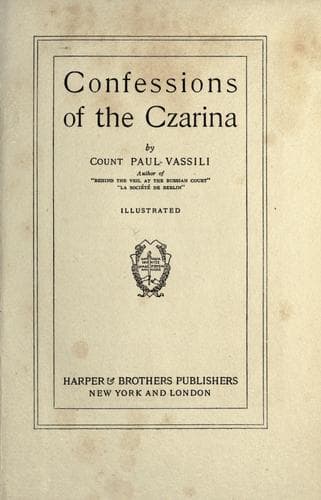
Confessions of the CzarinaRadziwill, Catherine, Princess
History
Confessions of the Czarina
Radziwill, Catherine, Princess
Alexandra, Empress, consort of Nicholas II, Emperor of Russia, 1872-1918; Russia -- Court and courtiers
How did all this happen? Who was responsible for the chaos into which
Russia is plunged at the present moment? It is next to impossible to say
to-day, though one may easily guess. All that the world knows is that
chaos has supervened, and that, thanks to this chaos, Germans have once
more re-entered Petrograd, by the back door, perhaps, but still
re-entered it, and what does this detail matter to them! What they
wanted was only to get there again; the rest would adjust itself as time
went on, and the general confusion became even more complete than it was
at the beginning.
Another feature in this extraordinary Revolution was the swiftness with
which the country accepted it and accommodated itself to its
consequences. In the space of a few hours the portraits of the Czar had
disappeared from all public places, the Imperial arms, wherever these
had graced a shop or concern of some kind, had followed suit. Ushers in
the former Imperial theaters had discarded their liveries, sentinels at
the Winter Palace had been removed, and the Red flag had taken the
place of the Romanoff standard on top of the Imperial Residence. All
this had been performed quietly, joyously, and in a perfectly orderly
manner. It seemed almost as if people had been prepared for a long time
for what was to come and had practised beforehand the various
manifestations of their joy to which they gave vent as soon as it became
known that the Guard regiments quartered in the capital had gone over to
the Duma and sworn allegiance to Mr. Rodzianko, its president.
Of the war there was no longer any question. It seemed to be forgotten
in the excitement of the hour, and somehow a general impression
prevailed that, once the Czar had been overturned, peace was but a
question of days. By one of those strange anomalies such as happen so
often in life, the Czar had been accused of wishing to bring this peace
about; yet when he was no longer there the world rejoiced at the thought
that peace would surely be concluded before any unreasonable quantity of
water had run through the Neva. It is also a singular feature of this
singular time that while Petrograd was in the throes of revolution,
while Ministers with Mr. Protopopoff at their head were being arrested
and transferred to the fortress, the Czar at headquarters and the
Empress at Tsarskoye Selo did not in the least suspect what was taking
place in the capital. It was said later that the Grand-Duke Paul had
forced his way into the apartments of Alexandra Feodorowna and had
acquainted her with the details of the upheaval which was to carry away
her Throne.
Public-domain text, read in full here on John Shaqi.
Reviews
Reviews
No reviews yet
Be the first to share your thoughts on this work.
Elsewhere in the archive
Join the Discussion
Join the discussion
Sign in to leave a comment or review.
Sign InorCreate an account