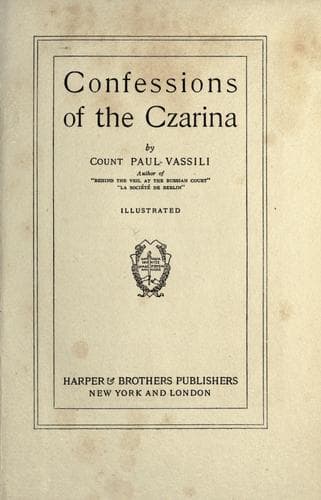
Confessions of the CzarinaRadziwill, Catherine, Princess
History
Confessions of the Czarina
Radziwill, Catherine, Princess
Alexandra, Empress, consort of Nicholas II, Emperor of Russia, 1872-1918; Russia -- Court and courtiers
An hour later a State carriage with outriders drove the newly wedded
couple from the Winter Palace to that of Anitchkoff where they were to
take up their residence with the Dowager Empress until their own
apartments were made ready for them. The bride was greeted with
vociferous cheers by the crowds. It was the one solitary occasion in her
life when she could have the illusion of being popular with her newly
acquired subjects. Eighteen months later these were to show to her in an
unmistakable manner that such was far from being the case, when she was
making her entry into that old town of Moscow, where the Imperial Crown
was to be put on her brow, to replace the orange flowers which had
adorned her head on her wedding morning.
II
MARRIAGE AND LONELINESS
One must be fair. The first months of the wedded life of the young
Empress Alexandra were not months of unmixed happiness. This, though
partly her fault, was also due to circumstances and the people who
surrounded her. Though the Consort of one of the mightiest monarchs in
Europe, she yet found herself relegated to an absolutely secondary
position; she discovered very quickly that no one considered her to be
of any importance whatsoever beside her mother-in-law, the
Dowager-Empress Marie. The latter had been one of the most popular
Sovereigns who ever graced a throne, and from the very first days after
her arrival in Russia she had applied herself to the task of pleasing
the people. Like her sister, Queen Alexandra, she identified herself
completely with the nation that now claimed her as its own, and she
entered into all its interests and pursuits, without any exaggeration,
but with that quiet, lovely dignity which never failed her, no matter in
what position she found herself. Her influence over her husband had
been immense, but no one had ever noticed it; on the contrary, she had
persistently remained in the background and tried to pass for a
pleasant, amiable, and just a little frivolous, woman who cared for
balls, pretty clothes, fine jewels, and the pomp which surrounded her at
every step she took. She held very properly the idea that it lowers a
Sovereign to appear to be under the sway and influence of his wife, and
so, though Alexander III. never took any decision of any importance
without having first of all discussed it with her, in public she avoided
not only talking politics, but even the appearance of being interested
in them.
Public-domain text, read in full here on John Shaqi.
Reviews
Reviews
No reviews yet
Be the first to share your thoughts on this work.
Join the Discussion
Join the discussion
Sign in to leave a comment or review.
Sign InorCreate an account