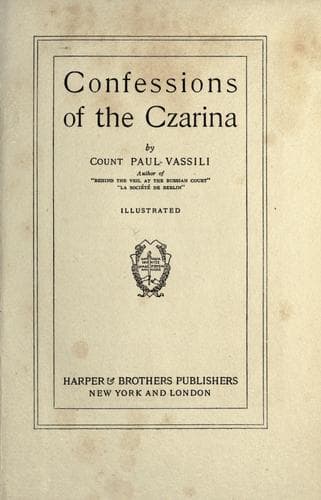
Confessions of the CzarinaRadziwill, Catherine, Princess
History
Confessions of the Czarina
Radziwill, Catherine, Princess
Alexandra, Empress, consort of Nicholas II, Emperor of Russia, 1872-1918; Russia -- Court and courtiers
The Czar might at this early stage of the Revolution have returned to
Tsarskoye Selo if he had only energetically insisted upon doing so. But
he spent three days in complete indecision, and when at last he made up
his mind to go home it was too late. By that time General Aléxieieff had
been won over to the cause of the Duma, which was supposed to represent
the only responsible authority in Russia; he put every possible obstacle
in his way, going so far as to interfere with the arrangements made by
General Woyeikoff for the departure of the Imperial train. It seems also
that he sent telegrams asking for this train to be either stopped or at
least delayed on its way.
No one at this stage wished Nicholas II. to go back to Petrograd, where
it was feared his presence would prevent, if not stop, the establishment
of the new Government; a useless fear, because, even if he had reached
his former capital, he would never have found sufficient courage or
energy to fight against an adverse fate or to do aught else but submit
to the will of the multitude eager for his fall. The man who signed
without one word of protest an abdication against which his whole soul
ought to have protested, such a man was not to be feared, he could only
be despised.
This was also the feeling which the whole nation began to entertain for
him. People had pitied him in the beginning, but as the details of his
conduct at Pskow became known, contempt took the place of any
commiseration which the tragedy of his fate might have provoked. This
opinion was so general that a friend of mine happening to discuss with
one of the Deputies of the Workmen in those Soviets which were being
organized just then the conduct of the former Czar, asked if he thought
it likely the life of the deposed ruler was in danger. He received this
characteristic reply:
“In danger? No. He is not worth a shot.”
It is likely that the Empress, if she had been asked her opinion, would
have agreed with this judgment. Though she had also thrown up her hands
and renounced the game, she would not have given up her rights to the
Crown that had been put upon her brow with such pomp and ceremony at
Moscow twenty-one years before. She would have fought against the
insolence of those who had come to demand it from her. Here I must say
that, according to the words of one of the two Deputies sent by the Duma
to interview Nicholas II. at Pskow, the prestige of the latter’s
personality as the anointed Czar of All the Russias was still so great
that if he had mustered sufficient energy to throw out of the railway
carriage the men audacious enough to claim his abdication, this gesture
of Imperial rage would have brought back to him the allegiance of the
troops. He was living through a terrible drama, and he was accepting it
like a comedy. After having disgraced himself, he was dishonoring by his
attitude the misfortunes which had fallen on his country, on his
dynasty, and on his race.
XXVI
A CROWN IS LOST
Public-domain text, read in full here on John Shaqi.
Reviews
Reviews
No reviews yet
Be the first to share your thoughts on this work.
Elsewhere in the archive
Join the Discussion
Join the discussion
Sign in to leave a comment or review.
Sign InorCreate an account