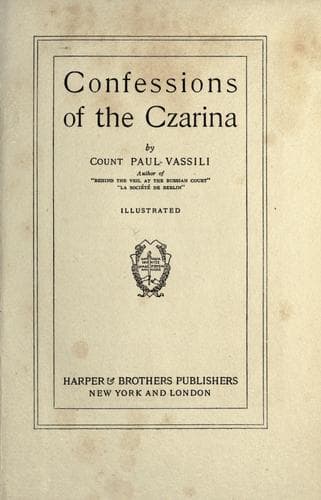
Confessions of the CzarinaRadziwill, Catherine, Princess
History
Confessions of the Czarina
Radziwill, Catherine, Princess
Alexandra, Empress, consort of Nicholas II, Emperor of Russia, 1872-1918; Russia -- Court and courtiers
News of her husband’s abdication reached her, and did not even rouse her
sentiments of revolt at a piece of weakness which, under different
circumstances, would have brought on one of those hysterical attacks to
which she had been subject. She understood that she was alone, quite
alone with the burden of her past sins and mistakes. She accepted with
stoical resignation the decrees of Destiny. Not one single feeling of
pity for the miserable Monarch for whose fall she was so responsible, or
for the children about to lose a glorious inheritance, moved her heart.
She was thinking the whole time of the dead man who had loved her and of
the murdered adventurer who had comforted her in the hours of her
greatest moral agony.
Nothing seemed to make any impression on her blurred mind--not even the
angry crowd when it appeared in the courtyard of the Palace where she
was still staying, carrying before it great banners upon which were
written the ominous words:
“Give us the head of Alexandra Feodorowna! We want the head of that
German woman, Alexandra Feodorowna!”
When asked to leave the window and not to appear before this multitude
clamoring for her blood, she merely shrugged her shoulders and remained
where she was. She certainly was not courageous, but she did not lack
bravery--the bravery born of fatalism or of indifference, which renders
those who are endowed with it impassible before danger, because they
fail to realize its importance or its imminence. This woman is a
historical riddle which only history will be able to unravel, but not so
soon as one imagines, because it is likely that she has not yet come to
the end of her sinister and mischievous career.
While the life of his wife was threatened, while his Ministers were
imprisoned, and while the nation was preparing to claim his abdication,
Nicholas II., at Mohilew, where headquarters were stationed, remained
just as indifferent to the convulsions which were shaking his country as
the Empress watching by the bedside of her sick children. He also did
not understand; he also failed to realize that what was taking place in
Petrograd was the first act of a big game the stakes of which might
easily come to be his own head and those of his family. The thought of
Louis XVI. never once crossed his mind. At least it is allowed one to
suppose so, because, when some officers of his suite remarked to him
that the rebellion (the news of which had by that time reached him) bore
many traits of resemblance to the premonitory riots that had heralded
the introduction of the Terror in France, he simply replied:
“Oh, it is not at all the same thing. Russians are not Frenchmen--and
the Romanoffs are not the Bourbons.”
Public-domain text, read in full here on John Shaqi.
Reviews
Reviews
No reviews yet
Be the first to share your thoughts on this work.
Elsewhere in the archive
Join the Discussion
Join the discussion
Sign in to leave a comment or review.
Sign InorCreate an account