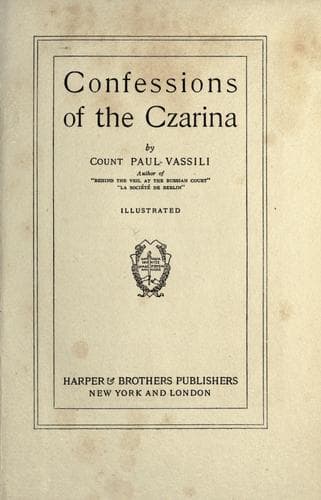
Confessions of the CzarinaRadziwill, Catherine, Princess
History
Confessions of the Czarina
Radziwill, Catherine, Princess
Alexandra, Empress, consort of Nicholas II, Emperor of Russia, 1872-1918; Russia -- Court and courtiers
Of course she was in a certain sense a strong character, in so far, at
least, as she never would yield to reason or accept any compromise. She
had principles of her own, which, however, did not help her to win
respect for herself or esteem for her conduct. Without ever allowing
herself to be led by impulse, she failed to perceive that in most of her
actions she was influenced by superstition of a most foolish kind. The
fact that insanity existed in her family may excuse her to a certain
point, but should not blind us to faults which might easily have been
corrected had she only realized their existence.
She was a blameless wife; about this there cannot be any doubt. But she
never loved her husband and she only cared for his position. She was a
tender mother, at least to her son, whatever may have been her feelings
in regard to her daughters, whom she most unjustly blamed for their sex,
if we are to believe all that we have been told on the subject. But she
lacked sympathy, which she never could give to others or win for
herself. She was a cold, ambitious, stern creature, so convinced of her
own perfection that she never could be brought to see good in anything
with which she was not connected in some way or other. Her life
certainly had tragedy entwined with its course. Perhaps the most cruel
blow, until the final catastrophe that wrecked all her hopes, had been
her unfortunate affection for the dashing officer, Colonel Orloff, who
had died to save her honor and good name, whose post-mortem influence
had been so cleverly made use of by unscrupulous adventurers in order to
win her confidence. Alexandra had always at heart despised the weak man
to whom she was married, but she had loved the high position which,
thanks to her union with him, she had acquired; she would have liked to
remain alone in control of it and to revenge her supposed wrongs at the
hands of the Russian nation, by delivering it into the power of that
German Fatherland of hers to which she had always remained attached. Her
desire for peace was sincere (at least we must hope so), and everything
we know about her and about her conduct during that momentous time when
she kept working toward its conclusion points to the truth of this
supposition. It had all along been a terrible trial for her to find the
land of her birth at war with that of her adoption, and to this initial
agony was added the superstitious terror which Raspoutine had inspired
in her, thanks to the hypnotic practices in which he had induced her to
participate--terror which ended by completely wrecking her already
badly balanced mind.
Public-domain text, read in full here on John Shaqi.
Reviews
Reviews
No reviews yet
Be the first to share your thoughts on this work.
Elsewhere in the archive
Join the Discussion
Join the discussion
Sign in to leave a comment or review.
Sign InorCreate an account