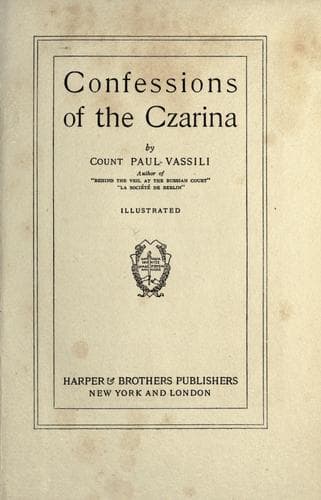
Confessions of the CzarinaRadziwill, Catherine, Princess
History
Confessions of the Czarina
Radziwill, Catherine, Princess
Alexandra, Empress, consort of Nicholas II, Emperor of Russia, 1872-1918; Russia -- Court and courtiers
But the supreme misfortune of the last Empress of Russia, a misfortune
for which she was not responsible, was the fact of her having been
married to a being who was too weak to lead her, too selfish to
understand her, too cruelly inclined to sympathize with her; who at the
same time did not acquire sufficient authority over her to inspire her
with respect for his individuality as a man and for his position as a
Sovereign. Had she been the wife of Alexander III., it is likely that
she would have turned out entirely another woman from the one which she
ultimately became; on the other hand, had Nicholas II. had for Consort a
person different from the one to whom destiny had linked him, it is also
probable that he would have contrived to avoid some of the mistakes into
which he fell. He might have shown himself more plucky and more human in
the different moments of crisis which made his reign such a sad and such
an unfortunate one.
One of the most tragical things with which a student of history finds
himself confronted when he analyzes any of the great catastrophes that
come to change the fate of nations is the total insufficiency of the
people who have to meet them or to handle them. There is no more pitiful
spectacle than the vacillations of Louis XVI. during the first days of
the great Revolution which sent him to the scaffold. Witness the want of
character of the miserable Czar who is meditating at present in Tobolsk
over the misfortunes that have landed him into exile; it is another of
those sights one should have liked to see spared to posterity. During
the twenty-two years he occupied the Russian Throne Nicholas II.
constantly opposed himself to the wishes of his people, even the most
reasonable ones, when he thought that they implied any diminution of his
personal prerogatives or power. He sent hundreds of thousands of
innocent people to the gallows or to horrible Siberian prisons under the
slightest of pretexts. He had no hesitation at spilling the blood of his
subjects either on the battle-field or on the scaffold. He allowed the
detestable police system, which became, under his rule, stronger than it
had ever been before, to interfere with private liberty and private
opinions to an extent that had never been witnessed in his country even
in the times of Nicholas I. or of Paul. While he reigned no one felt
secure in his home or could go to bed with the consciousness that he
would not be wakened in the middle of the night by an army of police
agents come to search his drawers, or to arrest him under the most
futile of pretexts or simply because he had refused to pay a bribe. And
yet that man in whose name the most terrible injustices had been
committed, who did not admit any resistance to his will, who believed in
his unlimited power over one hundred and eighty millions of human
beings--that man did not find sufficient courage to resist the only
demand, among the many which were addressed to him during the course of
Public-domain text, read in full here on John Shaqi.
Reviews
Reviews
No reviews yet
Be the first to share your thoughts on this work.
Elsewhere in the archive
Join the Discussion
Join the discussion
Sign in to leave a comment or review.
Sign InorCreate an account