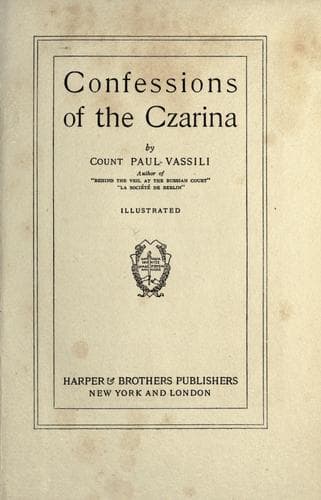
Confessions of the CzarinaRadziwill, Catherine, Princess
History
Confessions of the Czarina
Radziwill, Catherine, Princess
Alexandra, Empress, consort of Nicholas II, Emperor of Russia, 1872-1918; Russia -- Court and courtiers
It is to be doubted, also, whether he regretted what he had done.
Certainly he never imagined to what it would lead him. The idea that
his people would have the courage to make him a prisoner does not seem
to have crossed his mind, any more than did the fact that, once he had
lost his position, he had become not only a useless, but an embarrassing
factor in Russian politics. He went back to Mohilew, to the headquarters
of that army of which he had been the Commander-in-chief as well as the
Sovereign, quite naturally and in the same quiet manner he might have
done in the days gone by. He did not even seem to yearn after his wife
and children, and never once did he suggest the advisability of
returning to Tsarskoye Selo. Of all the people assembled around him he
appeared the most unconcerned. This indifference lasted even when he
found himself faced with captivity and when the former Head of his
Staff, General Aléxieieff, came to acquaint him with the decision of the
Provisional Government to arrest him.
His wife, left alone in the Palace where she had spent so many happy
days, did not perhaps share his indifference; she certainly displayed
the same apathy. Alexandra Feodorowna, from the moment that she saw her
schemes of personal grandeur frustrated, gave up the game; she gave it
up with more dignity than her husband had ever shown--this much must be
conceded to her. She never flinched before the insults that were poured
down upon her; she never gave a sign that she was moved to anything
else but disdain when General Korniloff read to her the orders of the
Government in regard to her person, and acquainted her with the fact
that she was a prisoner. She declared to the few people left with her
that she considered herself only as a Sister of Charity in attendance on
her sick children. The Empress had disappeared, outwardly at least, and
perhaps it was just as well that she accepted the situation in this way,
rather than attempt a useless resistance, which could only have added to
her unpopularity.
But still the fact remained that the whole Russian Revolution had been
conducted after the style of a comic opera of Offenbach. No one at first
had recognized its serious character. No one had seemed to realize that
it constituted the most portentous event of the last hundred years or
so. Those who had carried it out had done it on the spur of the moment,
without thinking of what would follow; and the Monarch who had bowed his
head under its decrees also had not suspected that a morrow was there,
waiting for the results of what was being done to-day. The historical
stick that had been wielded by Peter the Great had been transformed into
the ridiculous sword of the Grand Duchess of Gerolstein.
XXVII
A PRISONER AFTER HAVING BEEN A QUEEN
Public-domain text, read in full here on John Shaqi.
Reviews
Reviews
No reviews yet
Be the first to share your thoughts on this work.
Elsewhere in the archive
Join the Discussion
Join the discussion
Sign in to leave a comment or review.
Sign InorCreate an account