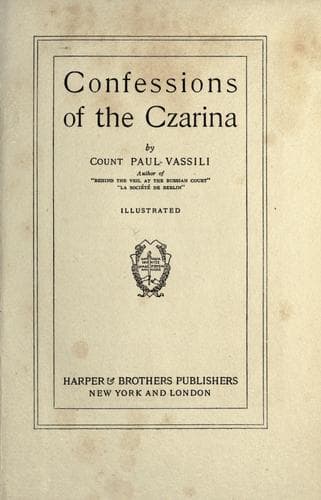
Confessions of the CzarinaRadziwill, Catherine, Princess
History
Confessions of the Czarina
Radziwill, Catherine, Princess
Alexandra, Empress, consort of Nicholas II, Emperor of Russia, 1872-1918; Russia -- Court and courtiers
A new life began for Alexandra Feodorowna. Until that fatal day when she
was taken into captivity her existence had been one of ease and luxury.
She had been the Empress of All the Russias, being revered by some as
almost a divinity, the absolute mistress of all her surroundings, with
servants in attendance on her, eager to execute any commands it might
please her to lay upon them. She had not a wish which was not instantly
gratified; the misfortunes that had assailed her (I am not speaking now
of those that fell upon Russia) had always left her indifferent; they
had existed more in her imagination than in reality. Suddenly without
warning and, what was even worse, at the very moment when she had
expected to reach even loftier heights than the one upon which she was
placed, she had been hurled down into an abyss of sorrow, of misery, and
of pain such as she had never imagined she could ever know. She was no
longer a Sovereign; her courtiers, servants, attendants, had all
vanished with the exception of a very few, and those she had never cared
for much, in the days of her prosperity. Her children were sick and she
could not even obtain for them a doctor’s help. Her friends had fled or
were in prison; her Crown had been wrested from her; she was a prisoner,
deprived of the means of communicating with her own people and
relatives; the guards who surrounded her Palace were no longer placed
there to protect her safety; they were intrusted with another mission,
that of watching over every one of her movements and of preventing her
from getting any news from the outside world. Instead of crowds gathered
to cheer her, she saw assembled under her windows an angry multitude
asking for her blood and calling out to her that she ought to be
punished as a traitor. She had no friends, no money, no influence any
longer. The dream had come to an end, and she found herself facing stern
reality, a reality against which it was useless to struggle.
Her husband came back to her, a prisoner, likewise, but with perhaps
less consciousness of the horror of their position than she had. They
had to settle down to a new life entirely different from the previous
one--a life of idleness, of inaction; an existence which made them
realize with every step they took the awful change that had overtaken
them. When they wished to go out they had to ask permission to do so
from an officer who often refused it out of pure malice. They had to
pass before sentinels who no longer presented arms to them, who only
sneered in their faces as they saw them hurry through a room or a
corridor, anxious to escape insult or outrage. No one was allowed to
come near them. They were condemned to a solitude in which they were
continually reminded of the days gone by forever.
Public-domain text, read in full here on John Shaqi.
Reviews
Reviews
No reviews yet
Be the first to share your thoughts on this work.
Elsewhere in the archive
Join the Discussion
Join the discussion
Sign in to leave a comment or review.
Sign InorCreate an account