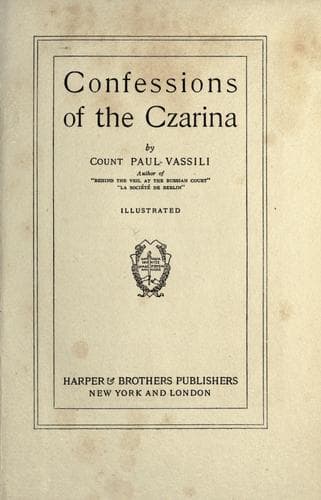
Confessions of the CzarinaRadziwill, Catherine, Princess
History
Confessions of the Czarina
Radziwill, Catherine, Princess
Alexandra, Empress, consort of Nicholas II, Emperor of Russia, 1872-1918; Russia -- Court and courtiers
But Nicholas, in the midst of all these miseries, preserved the same
impassibility he had displayed when the news of the disasters of Mukden
and Tsu Shima had been brought to him, or when he had heard that Warsaw
and the long line of fortresses that had defended the Russian frontier
on the Niemen and the Vistula had fallen into German hands. He accepted
everything with stoicism; he expressed no surprise at the blows which
were being hurled at his head. He simply remained indifferent, perhaps
because he was too much of a fatalist to rebel, but most probably
because he had not yet grasped the real significance of all that was
happening to him.
The Empress was not so resigned, in spite of her apparent apathy. She
had more reasons to fear for her personal safety than her husband, and
she knew very well that in case of a rising of the anarchists in
Petrograd she would be the first victim they would claim. This dread led
her into another of the mistakes which she was continually perpetrating,
the mistake of trying to call to her rescue her German cousin.
According to people whom I have reason to believe exceptionally well
informed, she caused certain information to be carried to the Kaiser. In
return for this she implored him to try and save her, together with her
children. Of course this became known to the Provisional Government, but
the latter wished to spare her, partly because it feared that if her new
misdeeds were published nothing could save her from the wrath of the
public, and it did not wish the Revolution to be dishonored by the
murder of a defenseless woman, whatever that woman might have done. But
the question of the transfer of Nicholas II. and of his family to a
place where he could be guarded more closely than at Tsarskoye Selo was
discussed seriously. It is likely that this would have been executed
already during the first six weeks which followed upon his abdication if
other things had not interfered, and if in rapid succession the men who
had taken up the task he had been unable to fulfil had not in their turn
disappeared one after the other, making room for Ministers more advanced
in their opinions and more devoid of scruples as to the punishment which
they believed ought to be inflicted on the former Emperor.
Public-domain text, read in full here on John Shaqi.
Reviews
Reviews
No reviews yet
Be the first to share your thoughts on this work.
Elsewhere in the archive
Join the Discussion
Join the discussion
Sign in to leave a comment or review.
Sign InorCreate an account