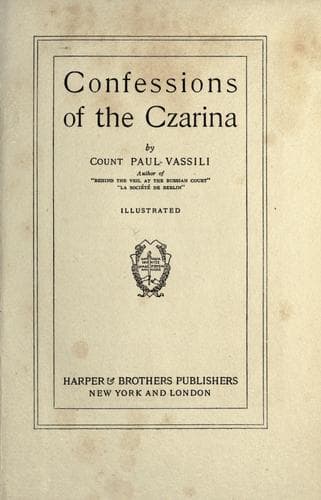
Confessions of the CzarinaRadziwill, Catherine, Princess
History
Confessions of the Czarina
Radziwill, Catherine, Princess
Alexandra, Empress, consort of Nicholas II, Emperor of Russia, 1872-1918; Russia -- Court and courtiers
The Empress caught at the opportunity, and from that day there was
established between them relations of the closest intimacy, linking the
Empress and the Lord of Potsdam. She took the habit of sending him a
kind of diary of what she was doing and of what went on at the Russian
Court--a diary in which she did not spare her mother-in-law, or her
husband, whom she reproached with not taking her part more openly.
Of course it was not easy to carry on such a correspondence. The young
Empress was closely watched, a fact of which she was but too well aware.
She tried the medium of the German Embassy, but apart from the fact
that it would have seemed a suspicious thing to send there letters in a
regular way, the Ambassador, Prince Radolin, refused to be the means of
forwarding messages of which he did not know the import, and did not
care to be involved in an intrigue that would inevitably have brought
him to grief if discovered. Some other way, therefore, had to be
devised, and for a time it seemed as if it would be next to impossible
to find any. Once or twice the Princess Hohenlohe, wife of the Imperial
Chancellor, who, through the fact that she was the owner of large
estates in Lithuania, often visited St. Petersburg, brought with her
messages from the Kaiser to the Empress Alexandra, and took back with
her to Berlin the latter’s replies. But this was not sufficient, and
during the first visit paid by the Czar and his Consort to the German
Court William and the young Czarina came to an understanding, after
which their correspondence continued through the medium of friends of
the Kaiser, who somehow appeared regularly in Russia whenever this was
considered necessary.
People, and there were some, who happened to be in the secret of this
intercourse pretended that one of the things which William II. urged
upon his cousin was the necessity of getting rid of the influence of the
Empress Marie, who, by reason of her avowed French sympathies,
constituted a danger to German expansion and to German progress in the
Muscovite Empire. The fact that for the present Alexandra Feodorowna was
still considered a nonentity at the Russian Court was not of much
importance because it was thought that if she were once to become the
mother of a son she would immediately be raised to the position of an
important personage in her husband’s house and country. And it must not
be forgotten that in the course of the summer of 1895 the Empress was
known to be about to give birth to her first child, who of course had to
be a boy and an Heir to the Russian Throne.
Alas, alas for these hopes!
Public-domain text, read in full here on John Shaqi.
Reviews
Reviews
No reviews yet
Be the first to share your thoughts on this work.
Join the Discussion
Join the discussion
Sign in to leave a comment or review.
Sign InorCreate an account