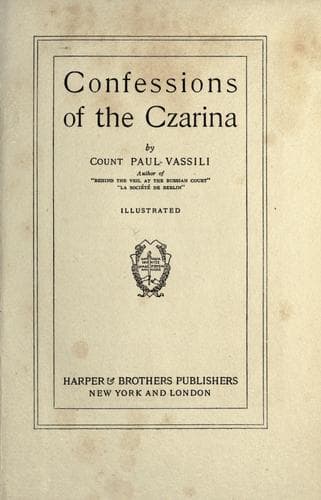
Confessions of the CzarinaRadziwill, Catherine, Princess
History
Confessions of the Czarina
Radziwill, Catherine, Princess
Alexandra, Empress, consort of Nicholas II, Emperor of Russia, 1872-1918; Russia -- Court and courtiers
But her brother’s prospective marriage changed considerably her
position. She would no longer occupy the position of the first lady of
her beloved Hesse; she would find installed in the place which had been
her own for so many happy years a woman younger than herself, with an
independent character, a determined mind, a woman who would most
probably grow very quickly to impose herself and her ways of thinking,
not only on the whole Hessian Court, but also on the Grand Duke, whose
sister was condemned beforehand to be neglected and treated as a
negligible quantity.
This was gall and wormwood to the passionate, selfish girl, and this
feeling of hers, which she allowed her cousin the Kaiser to guess, was
very cleverly exploited by the latter in view of a marriage which none
desired more ardently than himself. Next to his own sister, there was no
one in the whole world whom he would have more ardently wished to
become Empress of Russia than his cousin Alix. He invited himself to
Darmstadt for a short visit, and while there took the first opportunity
to discuss the subject with her. He told her what very few people knew
at the time, and what the general public was entirely ignorant of--the
serious nature of the illness with which Alexander III. was attacked, an
illness which gave no hope whatever of recovery. By marrying the young
Grand-Duke Nicholas the Princess would find herself but for a short time
in a so to say subordinate position. A few months would see her raised
to one of the greatest thrones in Europe, from the height of which she
would be enabled to look down with contempt and pity on the cousin who
was about to take at the Darmstadt Court the place she had occupied so
long she had grown to consider it as her very own.
Moreover, she would be able to win back Russia and its ruler to the
cause of the German alliance, and thus accomplish one of her duties as a
loyal German woman. He appealed to her worst instincts while seeming to
call on her noblest ones to assert themselves, and once more he won the
day.
In St. Petersburg, too, Hohenzollern influence and intrigues had worked
actively, until at last the Czar, feeling perhaps that his days were
numbered and perhaps also no longer strong enough to resist perfidious
advice given to him by interested people, yielded the point, and when
his eldest son started for Coburg to attend there the Princess Victoria
Mélita’s wedding, he authorized him to ask for the hand of Alix of
Hesse.
Public-domain text, read in full here on John Shaqi.
Reviews
Reviews
No reviews yet
Be the first to share your thoughts on this work.
Join the Discussion
Join the discussion
Sign in to leave a comment or review.
Sign InorCreate an account