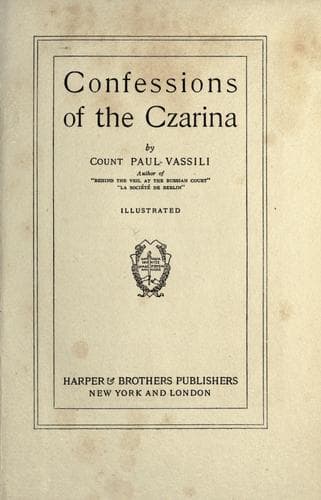
Confessions of the CzarinaRadziwill, Catherine, Princess
History
Confessions of the Czarina
Radziwill, Catherine, Princess
Alexandra, Empress, consort of Nicholas II, Emperor of Russia, 1872-1918; Russia -- Court and courtiers
I had not written the book out of any motives of revenge; on the
contrary, I had many reasons to be personally grateful to Nicholas II.
for various kindnesses I had met with at his hands; but it was
impossible for any real Russian patriot to gaze unmoved at the German
propaganda that was going on in the Empire, or to forgive its Sovereign
Lady for disgracing herself together with the crown she wore, by the
superstitious practices that had put her into the power of intriguing
persons who ultimately brought about her own destruction, together with
the ruin of the dynasty. It was impossible for any one who had known
Russia during the reign of Alexander III., when the whole of Europe had
its eyes turned upon her, and was clamoring for her alliance, not to
feel deeply grieved in noticing the signs of the coming catastrophe
which had been hovering in the air ever since the fatal Japanese war.
The Monarch had become estranged from his people and his wife was the
person responsible for it; or rather the people who had succeeded in
getting hold of her mind. I do not wish here to throw stones at
Alexandra Feodorowna, and in relating now what I know concerning her
life, I will try not to forget that misfortune has got claims upon human
sympathy, and that where a woman is concerned one is bound to be even
more careful than in the case of a man.
The former Empress of All the Russias is to-day a prisoner, condemned to
a horrible exile. She deserves indulgence; the more so that her follies,
errors, and mistakes were partly due to a morbid state of mind, verging
if not achieving actual insanity. Her existence, like that of the hero
in the beautiful poem of Félix d’Arvers, had its secrets, and her soul
its mysteries. The fact that she was a Sovereign did not shield her from
feminine weaknesses, and, though she had always remained an innocent
woman--a fact upon which one cannot sufficiently insist--in view of all
the calumnies which have been heaped upon her, yet, like the unfortunate
Marie Antoinette, to whom she has been more than once compared, she had
also met on her path the devotion of a Fersen, as accomplished, as
brave, and as handsome, as the Swedish officer whose name has gone down
to posterity, thanks to his love for the poor Queen who perished on the
scaffold of the Champs Elysées. While the latter was spared the sorrow
of losing such a faithful friend, Alexandra Feodorowna was destined to
be an unwilling witness of a cruel and unexpected tragedy, which ended
brutally any dreams she might have nursed in the secret of her heart,
and put her good name at the mercy of an infuriated man. Therein lies
the drama of her life; a drama the remembrance of which probably haunts
her to this day in the solitude of the lonely Siberian town, to which
she has been banished by a triumphant Revolution.
Public-domain text, read in full here on John Shaqi.
Reviews
Reviews
No reviews yet
Be the first to share your thoughts on this work.
Join the Discussion
Join the discussion
Sign in to leave a comment or review.
Sign InorCreate an account