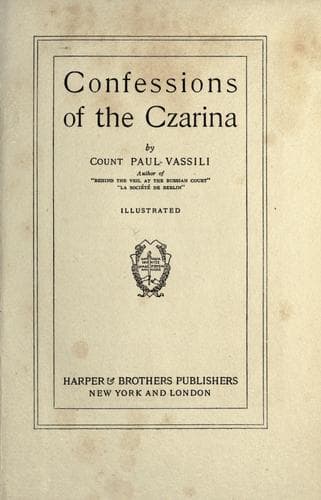
Confessions of the CzarinaRadziwill, Catherine, Princess
History
Confessions of the Czarina
Radziwill, Catherine, Princess
Alexandra, Empress, consort of Nicholas II, Emperor of Russia, 1872-1918; Russia -- Court and courtiers
It was not only her family and St. Petersburg society with whom the
Empress could not agree. Her relations with her husband were also not of
the best during the first years of her married life. Later on, when
Alexandra Feodorowna had fallen into the hands of the clever gang of
adventurers whose tool she was to remain until the final catastrophe
which drove her from her Throne had taken place, she contrived to get
hold of the feeble mind of Nicholas II., and to influence him
absolutely, thanks to his love for his children, especially for his son.
During the first five years or so that followed upon his marriage the
Czar, though he never quarreled with his wife, yet thought far less
about her than he did about his mistress, the dancer Mathilde
Krzesinska, a Pole of extreme intelligence, little beauty, but enormous
attraction. Their friendship had begun when Nicholas was but a boy, or
about that, rumor would have it, though I have reason for knowing
[Illustration: THE CZAR]
that in this rumor was mistaken, as happens so often to the old lady,
that the dancer had been chosen by the Empress Marie herself as a fit
friend for her eldest son. The fact was that this liaison had started
almost immediately after the Grand Duke’s return from his journey round
the world, which had had such a dramatic incident to enliven it in
Japan, when a fanatic had attempted to take the life of the Heir to the
Russian Throne, inflicting upon him a deep wound with his sword.
The Cesarewitsch had seen Mademoiselle Krzesinska on the stage of the
Marinsky Theater, and had been very much impressed by her talent and
grace. He had asked to be introduced to her, and had forthwith carried
her off to supper at a fashionable restaurant called Cubat, where all
the _jeunesse dorée_ of St. Petersburg used to meet, eat, drink, and be
merry. This supper, in which had taken part several of Nicholas’s
friends, officers in the same Hussar regiment where he was a captain, as
well as one or two ladies of great beauty and doubtful reputation, had
ended in a scandal, which for several weeks had been almost the only
subject of discussion in the aristocratic _salons_ of the capital. The
company had been enjoying itself so much that glasses and plates had
been broken; when, at two o’clock in the morning, the owner of the
restaurant had ventured to suggest that it would be high time the
entertainment came to an end, he had been sent to mind his own business.
This the poor man would have been but too glad to do, but police
regulations were very strict at that time, and he knew that if a patrol
should see light in his windows from the outside that he would be fined
heavily, no matter who had elected to remain in his establishment after
the curfew had sounded.
This was precisely what happened.
Public-domain text, read in full here on John Shaqi.
Reviews
Reviews
No reviews yet
Be the first to share your thoughts on this work.
Join the Discussion
Join the discussion
Sign in to leave a comment or review.
Sign InorCreate an account