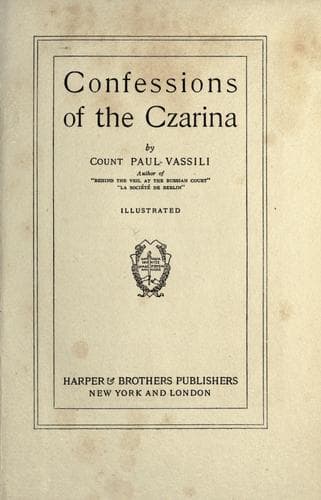
Confessions of the CzarinaRadziwill, Catherine, Princess
History
Confessions of the Czarina
Radziwill, Catherine, Princess
Alexandra, Empress, consort of Nicholas II, Emperor of Russia, 1872-1918; Russia -- Court and courtiers
At first her advances were met with rebuff; then gradually, seeing how
attentive and full of deference her cousin showed herself in respect to
her person, the young Empress began to thaw; and soon a friendship, the
more surprising that the two ladies did not seem to have anything
whatever in common in their respective characters--even a close
friendship--established itself between them, and the miserable wife of
Nicholas II. poured out the sorrows which racked her heart to the
willing ears of Stana Leuchtenberg, who, in her turn, related all her
own misfortunes. At last Alexandra interested herself so much in the
welfare of this other victim of an unhappy marriage that she exerted
all her influence to persuade the Emperor to grant her the permission to
sue for a divorce. At the same time she applied herself to invite the
Grand-Duke Nicholas as often as possible either at Tsarskoye Selo or at
Livadia, and to make him meet there the beautiful Stana Leuchtenberg.
The expected happened, and soon poor Madame Bourénine was forgotten, and
the betrothal of the Empress’s two protégés was announced, much to the
indignation of the man in the street, who did not approve of it by any
means.
The Grand-Duke Nicholas was in his way just as ambitious a man as the
fair Montenegrin he had married. To the Crimea they both repaired as
soon as the divorce of the Princess had been pronounced. He knew very
well the weakness which characterized his nephew, the Czar, and he would
have dearly liked to become the latter’s chief adviser and even his
Prime Minister. He therefore favored his new wife’s intimacy with the
Empress, so that the couple were often seen at Tsarskoye Selo, much more
so, in fact, than any other members of the Imperial Family.
Now the Grand Duke had one weakness. He believed in spiritualism, in
turning tables, and all kinds of superstitious extravagances. The
Empress’s leanings had also since some time been directed toward the
same subject, but she had felt afraid to speak about it, knowing very
well that this would not be looked upon with lenient eyes by the Czar or
by his mother. When she discovered, however, that Nicholas
Nicholaievitch did not feel in the least ashamed if he were caught
trying to communicate, through the medium of a table or of a pencil,
with the inhabitants of the other world, she confided to him her great
desire to do the same thing. The Grand Duke replied that nothing could
be easier. They held several séances to which the Emperor also came,
attracted by the descriptions which his cousin had made to him. Nicholas
Nicholaievitch promised the Empress that he would bring to her a famous
French medium called Philippe, who would most certainly make her witness
most extraordinary performances in regard to the evocation of the
spirits of people dead long before.
Public-domain text, read in full here on John Shaqi.
Reviews
Reviews
No reviews yet
Be the first to share your thoughts on this work.
Join the Discussion
Join the discussion
Sign in to leave a comment or review.
Sign InorCreate an account