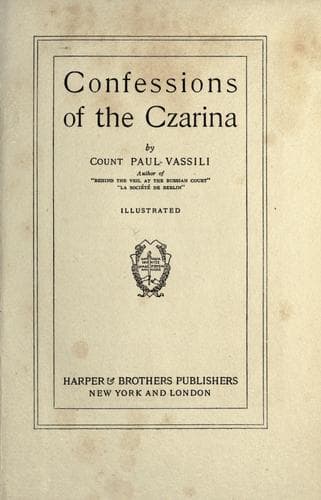
Confessions of the CzarinaRadziwill, Catherine, Princess
History
Confessions of the Czarina
Radziwill, Catherine, Princess
Alexandra, Empress, consort of Nicholas II, Emperor of Russia, 1872-1918; Russia -- Court and courtiers
This promise, given in the solemn moment when the weight of his new
duties and responsibilities was laid upon him, the late Czar had always
kept faithfully, honestly, with a steadfast purpose and an indomitable
will. He had put upon his program among other things the resolution
never to complain at any personal ailment or misfortune that he might
find himself obliged to bear. This resolution he kept up to the last
moment, and he went on working at his daily task until at last the pen
fell from his weary fingers and he had to own himself beaten. But during
the last memorable year of his life he must have more than once felt
that the end was drawing near, though he never spoke about it, with the
exception of once, when finding himself alone with one of his intimate
friends, General Tcherewine, he told him that he did not think he had
long to live, adding, sadly:
“And what will happen to this country when I am no longer here?”
The General became so alarmed at this avowal of a state of things he had
suspected, without daring to acknowledge, that he tried to open the
eyes of Empress Marie as to the state of health of her husband. But the
Czarina refused to see that anything was the matter, and angrily
reproved the General for daring to suggest such a thing. The latter
subsided, and sought one of the doctors who were generally in attendance
on the Emperor, asking him to tell him honestly his opinion concerning
the Czar. The doctor retrenched himself behind professional secrecy, and
only replied vaguely. The truth of the matter was that he did not wish
to own that he had been rebuffed by Alexander III. when he had asked the
latter to allow him to make an examination of him, and that he had never
dared to insist on its necessity.
At this time, when his father’s life was trembling in the balance, the
heir to the Russian Throne, the Grand-Duke Cesarewitsch, was twenty-six
years old. If the traditions of the House of Romanoff had been adhered
to in regard to him, he ought to have been married already, as it had
been settled by custom that the eldest son of the Czar ought as early as
possible to bring home a bride, so as to insure the succession to the
crown. But the Empress Marie had never looked with favor at the
possibility of seeing her family circle widened by the advent of a
daughter-in-law, and whenever the question of the establishment of her
eldest son was raised she always found objections to offer against any
princess whose name was mentioned to her as that of a possible wife. The
French party at the Imperial Court, which at that moment was in
possession of great influence, tried hard to bring about the betrothal
of the future Czar with the Princess Hélène of Orléans, and at one time
it seemed as if it would be really possible to arrange such a marriage,
in spite of the difference of religion.
Public-domain text, read in full here on John Shaqi.
Reviews
Reviews
No reviews yet
Be the first to share your thoughts on this work.
Join the Discussion
Join the discussion
Sign in to leave a comment or review.
Sign InorCreate an account