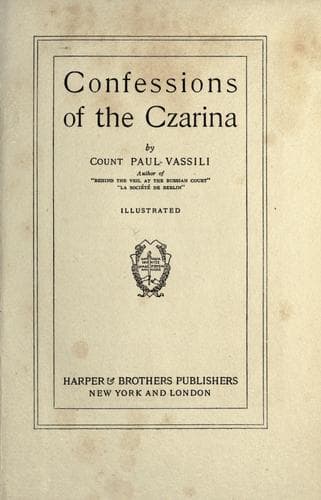
Confessions of the CzarinaRadziwill, Catherine, Princess
History
Confessions of the Czarina
Radziwill, Catherine, Princess
Alexandra, Empress, consort of Nicholas II, Emperor of Russia, 1872-1918; Russia -- Court and courtiers
The Empress alone said nothing. She was present at all the funeral
services which were celebrated over the coffin of the young officer, but
so was Nicholas II. Her attendance could not be considered as an
extraordinary thing. No one, with the exception of Anna Wyrubewa, who
had accompanied her, knew that on the night preceding the funeral of her
friend Alexandra Feodorowna had proceeded alone and unattended, save
for her, to the house where his mortal remains lay in state, and had
spent an hour praying beside his dead body and weeping bitter tears.
Outwardly, however, her calm had remained unshaken; and she had
succeeded in quite a wonderful way in keeping her feelings under
control. The only thing which she had insisted upon was to have Colonel
Orloff buried in the cemetery of Tsarskoye Selo, where she had a simple
monument, consisting of a large white marble cross, erected. She used to
go every day to pray there, and to leave flowers on this tomb which
represented for her so many hopes, and perhaps something else besides.
Of course these visits became known, but by a wonderful miracle they
were not commented upon in the way they might have been. The reputation
for eccentricity of Alexandra Feodorowna had by that time become so well
established that people had left off wondering at anything she might
attempt to do, and, besides, every one believed that the Colonel’s death
had been somehow connected with a love intrigue he had carried on with
Anna Wyrubewa, whose divorce lent ground for such a theory. It was
suspected or guessed that something had taken place in her house, but no
one could exactly ascertain what this something had been, and Wyrubew
himself had been for once thoroughly frightened, and had come to the
conclusion that the best thing he could do for his own sake as well as
for that of others was to hold his tongue, and to accept the divorce
upon which his wife insisted. Later on, however, he unburdened his soul
to some of his particular friends, but that happened at a time when
people were thinking of other things than the tragical death of an
officer whose existence was already forgotten by most of those who had
known him.
Public-domain text, read in full here on John Shaqi.
Reviews
Reviews
No reviews yet
Be the first to share your thoughts on this work.
Elsewhere in the archive
Join the Discussion
Join the discussion
Sign in to leave a comment or review.
Sign InorCreate an account