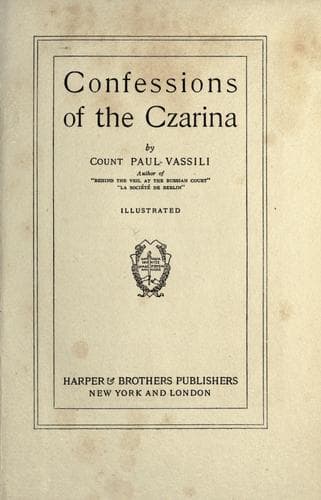
Confessions of the CzarinaRadziwill, Catherine, Princess
History
Confessions of the Czarina
Radziwill, Catherine, Princess
Alexandra, Empress, consort of Nicholas II, Emperor of Russia, 1872-1918; Russia -- Court and courtiers
As for the Empress, she had, as we have seen, borne herself wonderfully
well in the first moments which had followed upon the tragedy, but
afterward her nerves gave way entirely, and it was then that she had to
be kept in strict seclusion, and under the care of trained nurses. It
was said that her reason had given way under the load of her anxiety for
her small son, and that the thought of his serious condition had weighed
down so thoroughly on her mind that she had grown melancholy to an
alarming extent. The story was believed perhaps because it suited so
many people to think that it was true, and, besides, the political
situation in Russia was becoming so alarming that it entirely absorbed
public attention. The war with Japan had come to an ignominious end, and
shown the many failings, as well as the thorough insufficiency, of the
Government. The first symptoms of the Revolution were clearly appearing
on the horizon, with its attendant horrors. Everybody felt that
something had to be done in order to avert a catastrophe the extent of
which it was impossible to foresee, but which was generally considered
as being inevitable, unless the Czar made up his mind to grant the
reforms for which his whole Empire was clamoring.
During those years, which were the prelude of other even more eventful
ones that were later on to sweep away the Throne of the Romanoffs,
Nicholas II. might still have regained the popularity which he had lost.
If he had only bravely and courageously faced his people, and tried to
get into direct contact with them, he could have secured for his dynasty
a new lease of life. He was not liked, it is true, and he was not
trusted, which was still worse; but nations are sometimes apt to be led
by impulse, and it is certain that Russia would have felt grateful to
him if he had only made an appeal to its loyalty for his person, and
asked of her to help him in the task of repairing the wounds caused by
the disastrous campaign that had come to an end with the signature of
the Treaty of Portsmouth.
But the Czar ignored the wishes of his subjects and refused to
acknowledge the justice of their claims to be taken into his confidence.
He was narrow-minded, cruel by disposition, and though not at all an
autocrat, yet every inch a tyrant. He was even something worse than
that; he was a coward, and this is a defect which neither nations nor
women forgive in those to whom they find their destinies intrusted.
The remembrance of that dreadful Sunday when a crowd of peaceful
workmen, under the leadership of the afterward notorious priest, Gapone,
marched toward the Winter Palace, to be met with the firing of
machine-guns that laid them low by hundreds on the pavement--the
remembrance of this bloody deed has never been effaced from the mind of
the Russian nation. It traced between itself and its Czar a line of
demarcation which could never be removed later on.
Public-domain text, read in full here on John Shaqi.
Reviews
Reviews
No reviews yet
Be the first to share your thoughts on this work.
Elsewhere in the archive
Join the Discussion
Join the discussion
Sign in to leave a comment or review.
Sign InorCreate an account