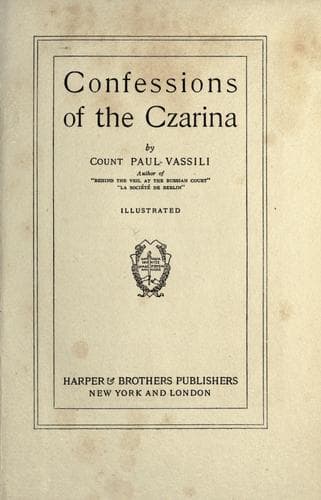
Confessions of the CzarinaRadziwill, Catherine, Princess
History
Confessions of the Czarina
Radziwill, Catherine, Princess
Alexandra, Empress, consort of Nicholas II, Emperor of Russia, 1872-1918; Russia -- Court and courtiers
It was thus that Alexandra Feodorowna met the man who was to have such a
baneful influence over her whole life, whose fatal influence was to
estrange her, still deeper than was already the case, from her subjects,
and to give rise to the flood of calumnies in which she was ultimately
to be drowned; and to perish, dragging along with her this mighty
Russian Empire whose Crown she wore and whose people she had never
understood nor even tried to understand.
Anna Wyrubewa was delighted to see that her beloved Czarina had really
found some comfort in listening to Raspoutine’s prayers. She believed in
the “Prophet” who had found favor in the eyes of the Lord, and whose
intercession in regard to the little Alexis would be crowned with
success. The woman was superstitious to the backbone, and perhaps more
mystically inclined even than most Russians are, which is saying a good
deal. She thought, at all events, that, once the Empress got to be
persuaded that she had to look to God alone for the recovery of her son
from a disease that had been pronounced to be incurable by the best
medical authorities, she would no longer fret as she had done, but begin
to look at things from a religiously fatalistic point of view. She hoped
also for another thing, and that was that the Czarina, once she had been
taught to look above for comfort and consolation, would cease to lament
over the “might have been” that has already caused so much heartburnings
in this world, and that she would leave off reproaching herself, as she
was constantly doing, for the death of the one man she had cared for,
whom in all innocence she had sent to his destruction, and who had
bravely preferred to disappear rather than allow a stain to rest upon
her honor. She had guessed the agony of the self-reproach under which
the soul of Alexandra Feodorowna had almost collapsed, and the remorse
which had racked it until her intelligence had almost snapped, through
the moral as well as through the physical pain which had clouded all her
faculties. She hoped, therefore, seriously and earnestly, that the
prayers of Raspoutine might ease this mental distress which had
transformed the Empress of All the Russias into a half-demented woman.
When she saw that his prayers had over the latter the beneficent
influence she had expected, she determined to do her best to induce her
to give her confidence to this man in whom her exalted imagination saw a
savior as well as a friend.
This was the real beginning of the Raspoutine intrigue, and it would
have been a lucky thing for all those who came afterward to be concerned
in it if it had stopped at this stage, and not been transferred to a
more dangerous one, the stage upon which European politics had to be
played and, unfortunately for Russia, played by utterly unskilful hands.
The comedy of Raspoutine did not last longer than a few months. Its
drama dragged on for years, and is not yet over by a long way.
XVI
SHE SAW HIM ONCE MORE
Public-domain text, read in full here on John Shaqi.
Reviews
Reviews
No reviews yet
Be the first to share your thoughts on this work.
Elsewhere in the archive
Join the Discussion
Join the discussion
Sign in to leave a comment or review.
Sign InorCreate an account