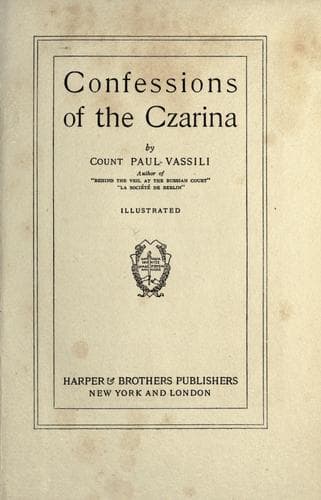
Confessions of the CzarinaRadziwill, Catherine, Princess
History
Confessions of the Czarina
Radziwill, Catherine, Princess
Alexandra, Empress, consort of Nicholas II, Emperor of Russia, 1872-1918; Russia -- Court and courtiers
should be continued and not be limited to a single interview, to do
aught else but assume the attitude of a man entirely absorbed in God and
in the practices of religion. When he was introduced to Alexandra
Feodorowna at the house of Anna Wyrubewa, he therefore remained standing
before her, in an attitude of apparent humility, and he waited quietly
until she should begin talking with him, which she immediately did,
saying that she had heard so much about him that she had wished to see
him and to ask him to pray for her little boy, whose state of health
gave rise to so much anxiety and worry.
Raspoutine looked at her, then replied quietly that he would be happy to
pray for the child, but that he thought she was just as much in need of
prayer as her son because her state of moral health was far more
alarming than Alexis’s physical one.
The Empress was so amazed that she could not find a reply to what
appeared to her in the first moment to be an unsurpassed piece of
insolence. Anna Wyrubewa saw what was taking place in her mind, and,
addressing her in English, a language which they always spoke together,
implored her not to feel offended, as the man really did not know what
he was saying, sometimes being urged by a strength superior to his own
to give utterance to thoughts he would never have dared to express
otherwise. She then urged the Czarina not to carry on the conversation
further, but to ask Raspoutine to begin at once praying for her welfare,
and also for that of Russia and of the Imperial Family.
Alexandra acquiesced, and the preacher proceeded to set himself before
the icon which, as is usual in all Russian houses, was hanging in a
corner of the room. He began long litanies which he recited in a
peculiar deep tone of voice, that rose up louder and louder as gradually
he worked himself up into a state of religious frenzy akin to the one
displayed by the dancing and howling dervishes in Turkey. But whether or
not his manner or the tone of his supplications or his personal
influence was the cause of it, the Empress as she listened to him felt
calmer and quieter than she had done for years. It seemed to her as if a
great peace was stealing upon her after the despair and the sadness in
which her days had been spent during the last months. When at last
Raspoutine’s orisons came to an end she was weeping silently, but all
the nervous excitement under which she had been laboring at the
beginning of the interview seemed to have disappeared and she looked
more like a normal woman than she had done since the day when Orloff had
said his last good-by to her in the boudoir of Anna Wyrubewa.
She silently extended her hand to the “Prophet,” saying as she did so:
“You have done me a great deal of good, and I thank you with all my
heart. I shall ask you again to pray for me.”
Public-domain text, read in full here on John Shaqi.
Reviews
Reviews
No reviews yet
Be the first to share your thoughts on this work.
Elsewhere in the archive
Join the Discussion
Join the discussion
Sign in to leave a comment or review.
Sign InorCreate an account