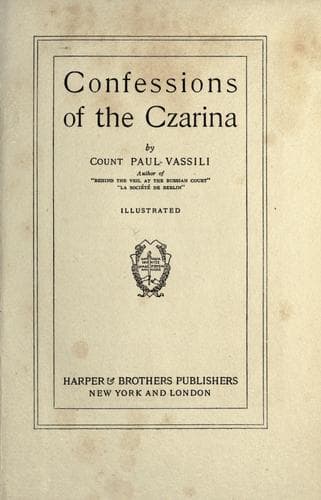
Confessions of the CzarinaRadziwill, Catherine, Princess
History
Confessions of the Czarina
Radziwill, Catherine, Princess
Alexandra, Empress, consort of Nicholas II, Emperor of Russia, 1872-1918; Russia -- Court and courtiers
This was but the first scene of many of the same character. The Czarina
recovered her scared senses with the full conviction that she had really
seen the spirit of the man she had loved so dearly; she was very soon
persuaded that he had been allowed to show himself to her and that he
would henceforward watch over her and guide her with advice and
encouragement in her future life. She quite believed that Raspoutine,
whom she sincerely thought to be in total ignorance as to that episode
in her life, was a real Prophet of God, and that, thanks to him, she
would be able to communicate with the dead. Whether Anna Wyrubewa shared
this conviction or not it is difficult to say, but it is not likely that
either Raspoutine or Maniuloff confided in her. They knew too well the
small reliance that, as a rule, can be placed upon feminine secrecy, and
the game they were playing was far too serious for them to run the risk
of compromising it by an indiscretion. It is therefore far more probable
that they also played upon the superstitious feelings of the Empress’s
friend, and that they used both ladies for the furtherance of their own
nefarious schemes with as much unscrupulousness as consummate art.
XVII
MY SON! I MUST SAVE MY SON!
After the episode which I have just related, there was no longer any
question of Raspoutine being allowed to leave the proximity of the
Imperial Court. The Empress came to have such utter confidence in him
that she even tried to induce the Czar to consult him; this he refused
to do, but, seeing how much brighter his wife had become since her
acquaintance with the “Prophet,” he made no objection to her seeing him.
One must here remark that both Raspoutine and his chief adviser,
Manassavitch-Maniuloff, played their cards wonderfully well by avoiding
every appearance of mixing themselves up with politics. The “Prophet”
talked with the Empress when he had the opportunity to do so, which, by
the way, was not so frequent as might have been supposed. His
conversations were always confined to religious subjects. He was very
carefully coached by his accomplice every time he had to meet Alexandra
Feodorowna, and he used to relate to her some sensational supernatural
stories, which a man of his ignorance could not possibly have learned if
he had not been inspired by the Almighty, as she fondly imagined. Her
superstitious feelings had entirely taken the upper hand of her reason
in all matters where Raspoutine was concerned, and she truly believed
him to be a Prophet of God, whose every word was inspired by Heaven,
whose intercession in her behalf had decided the Almighty to cure her
son of a disease which all the doctors who had seen him had pronounced
to be quite incurable.
Public-domain text, read in full here on John Shaqi.
Reviews
Reviews
No reviews yet
Be the first to share your thoughts on this work.
Elsewhere in the archive
Join the Discussion
Join the discussion
Sign in to leave a comment or review.
Sign InorCreate an account