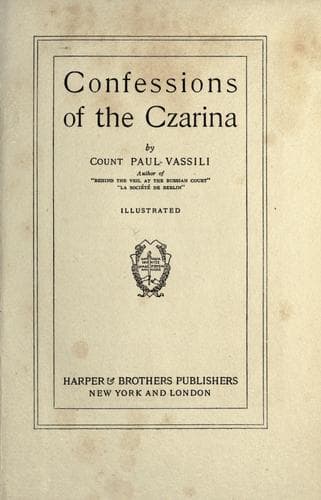
Confessions of the CzarinaRadziwill, Catherine, Princess
History
Confessions of the Czarina
Radziwill, Catherine, Princess
Alexandra, Empress, consort of Nicholas II, Emperor of Russia, 1872-1918; Russia -- Court and courtiers
In the mean while, although the relations of the Czarina with the crafty
adventurer who had succeeded in captivating her confidence remained
restricted to the purely religious ground, people were talking about
them, trying to turn them into a vast agency where everything in the
world could be bought and sold, providing the necessary money was
forthcoming to do it. Manassavitch-Maniuloff, thanks to the numerous
spies whose services he could command for a consideration, started to
spread the rumor that Raspoutine had become all powerful in Court
circles, and that if only one applied to him one could bring through the
most difficult kind of business. It must be remembered that at the time
I am referring to (the five years or so immediately preceding the war)
Russia had been transformed into a vast stock-exchange, thanks to the
mania for speculation which, since the Japanese war, had seized hold of
the public. Industry always more or less neglected had suddenly taken a
new and unexpected lease of life, and banks did a roaring business in
selling and buying for the account of the innumerable speculators who
rushed to invest their money. Nothing mattered in that respect save the
quotation of yesterday and the one expected or hoped for to-morrow.
Government contracts for all kinds of things, especially contracts
connected with the railway business and with factories of every sort,
were eagerly sought for. In the fight which was taking place to obtain
them every possible argument was employed. The art of Maniuloff and of
his friends, because he was not alone in this detestable business,
consisted in persuading others, even men in power who ought to have
known better, that Raspoutine, through his connection with the powers
who ruled at Tsarskoye Selo, could get for them such contracts that he
expected in return a solid commission, which, of course, was never
refused to him.
How long this kind of thing would have gone on it is difficult to say if
Mr. Stolypine, who was at the time Prime Minister, had not had his
attention drawn toward the activity of the “Prophet.” Not knowing very
well what to make of the conflicting reports which were brought to him,
he expressed one day the desire to meet Raspoutine. After the interview
he uttered his famous phrase:
“The only use the man could be put to was to light the furnace of the
house he was living in.”
Public-domain text, read in full here on John Shaqi.
Reviews
Reviews
No reviews yet
Be the first to share your thoughts on this work.
Elsewhere in the archive
Join the Discussion
Join the discussion
Sign in to leave a comment or review.
Sign InorCreate an account