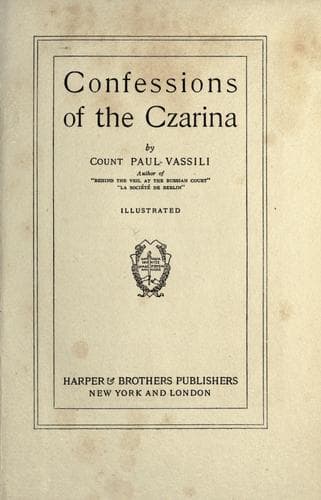
Confessions of the CzarinaRadziwill, Catherine, Princess
History
Confessions of the Czarina
Radziwill, Catherine, Princess
Alexandra, Empress, consort of Nicholas II, Emperor of Russia, 1872-1918; Russia -- Court and courtiers
The words were repeated, of course, to the person whom they concerned,
and they proved the death sentence of Stolypine, because his “removal”
by fair or by foul means was decided immediately after he had uttered
them. Stolypine, however, in spite of his apparent disdain for the
strange personality of Raspoutine, was far too clever not to realize
that the constant presence of this man by the side of the Empress of
Russia was likely to lead to gossip of a dangerous kind, if not to
various complications. He tried at first to get rid of him by diplomatic
means, and enrolled the sympathies of the Grand-Duchess Elisabeth, the
eldest sister of Alexandra Feodorowna, who, by reason of her having
embraced a religious life, was in possession of great respect everywhere
and could say what she liked to the Czar as well as to the Czarina. The
Prime Minister explained to her that it was to the highest degree
harmful for the reputation of the Imperial dynasty in general to see its
heads give way to a superstition which only evoked ridicule on the part
of reasonable people. Elisabeth Feodorowna promised that she would try
what she could do, but after a while she had to acknowledge that at the
first words she had spoken concerning the advisability of sending
Raspoutine back to his native village of Pokrowskoye in Siberia the
Empress had interrupted her so angrily that she had not been able to go
on with the conversation.
Stolypine was not a man to stop at half-measures. He asked no one’s law
or leave, and in virtue of his powers as Prime Minister he had the
“Prophet” exiled from the capital at twenty-four hours’ notice.
Raspoutine wished to communicate with the Empress as soon as the order
to leave St. Petersburg was signified to him, but he was prevented from
doing so by his friend, Manassavitch-Maniuloff, who assured him that it
would be far wiser not to murmur, and to accept the decree of banishment
issued against him; because in that way he would acquire far more
sympathy than would be the case if he rebelled; besides, in his absence
it would be relatively easy to play upon the nervous temperament of the
Empress to such an extent that after he had been recalled he would never
stand again the risk of a second dismissal. This was accordingly done
and Alexandra Feodorowna found herself alone, deprived of the
possibility of going on with religious practices that had gradually
assumed the character of those indulged in by that sect of the Khlystys
to which Raspoutine belonged.
Public-domain text, read in full here on John Shaqi.
Reviews
Reviews
No reviews yet
Be the first to share your thoughts on this work.
Elsewhere in the archive
Join the Discussion
Join the discussion
Sign in to leave a comment or review.
Sign InorCreate an account