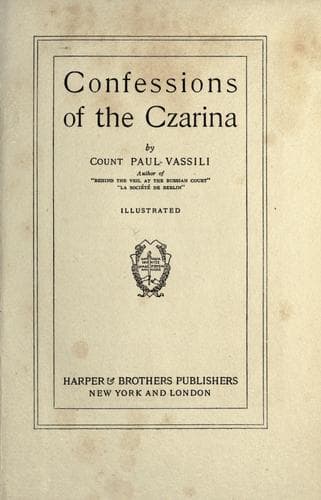
Confessions of the CzarinaRadziwill, Catherine, Princess
History
Confessions of the Czarina
Radziwill, Catherine, Princess
Alexandra, Empress, consort of Nicholas II, Emperor of Russia, 1872-1918; Russia -- Court and courtiers
The Czarina caught eagerly at the idea, and after long negotiations,
which very nearly failed because Raspoutine did not yield at once to the
entreaties sent to him, he at last consented to return to St.
Petersburg. He was secretly introduced into the room where the Heir to
the Russian Throne was lying, in what every one thought were already the
throes of death. He prayed for the child, he prayed for the Empress, and
he urged the latter to submit to certain mysterious passes which he
proceeded to perform over her head. A few days after this secret
interview Alexis suddenly began to improve; not only this, but he became
stronger and brighter than he had been for a long time.
Alexandra Feodorowna was radiant, and one day when Nicholas II. was
rejoicing at the happy change which had taken place in the condition of
their son she informed him of what she had done and begged from him
permission to bring Raspoutine to him and to allow him to remain in the
vicinity of the Court in the future. Nicholas II. was convinced and
granted the necessary authorization. After this the question of
Raspoutine’s return to Siberia was not raised again, and he never left,
except for short vacations, the Sovereigns who had at last been
persuaded to give to him their complete confidence.
He refused, however, to take up his abode in Tsarskoye Selo, and showed
himself very discreet in his demeanor. He was admirably advised, and he
prepared himself in silence for the part it was intended for him to play
in the future. But at stated intervals, and upon
[Illustration:
Copyright by Underwood & Underwood
THE PALACE OF TSARSKOYE SELO]
stated days, he used to see the Empress, either in her own rooms or,
most frequently, at the house of Anna Wyrubewa, when he evoked for her
the spirit of Colonel Orloff and transmitted messages which he was
supposed to have received. Alexandra Feodorowna believed him, and this
new understanding, which she firmly thought had, thanks to the prayers
of the “Prophet,” established itself between her and the man who had
possessed her heart, proved to her the greatest consolation she had
known. It induced her to come out of her retirement and to begin to take
part in the management of public affairs, which she insisted upon the
Czar communicating to her. The time was coming when it would become
known in Russia that if the Sovereign was a weak man his Consort was
trying to show herself a strong woman, and comparisons between Alexandra
Feodorowna and Catherine the Great began to be heard in the yet small
circle which affected to admire the new qualities it prided itself upon
having discovered in the young Empress.
XVIII
ANOTHER WAR
Public-domain text, read in full here on John Shaqi.
Reviews
Reviews
No reviews yet
Be the first to share your thoughts on this work.
Elsewhere in the archive
Join the Discussion
Join the discussion
Sign in to leave a comment or review.
Sign InorCreate an account