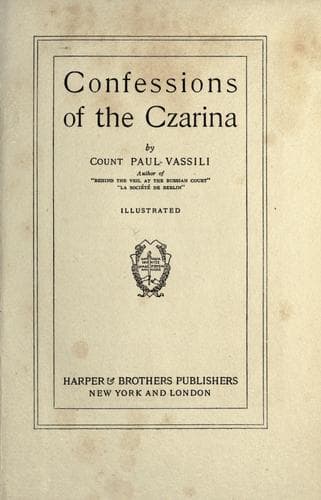
Confessions of the CzarinaRadziwill, Catherine, Princess
History
Confessions of the Czarina
Radziwill, Catherine, Princess
Alexandra, Empress, consort of Nicholas II, Emperor of Russia, 1872-1918; Russia -- Court and courtiers
The years which followed upon Raspoutine’s triumphant return to
Tsarskoye Selo were most eventful ones for Russia as well as for the
Imperial Family. Europe, too, went through political convulsions which
were the preliminary of the disaster that was to sweep over it in 1914,
but in which very few people in 1912 were able to discern danger. I am
referring to the annexation by Austria of Bosnia and Herzegovina and to
the two Balkan wars. When Servia was threatened by Bulgarian ambition
there existed a powerful party in Russia which would have liked the Czar
to interfere on her behalf, and to lend her his aid against King
Ferdinand, on one side, and the Austrian spirit of conquest, on the
other. Popular feeling was very much in favor of a Russian
demonstration, and for some weeks St. Petersburg was the scene of a
violent agitation which, in the opinion of many people, was destined to
end in a war with the Austro-Hungarian monarchy. It was not a secret
that the Servian Government would not have objected, had such a
contingency presented itself, and during the whole of the summer and
autumn of 1913 different Servian politicians came to Russia to discuss
the situation. In Moscow, as well as in St. Petersburg, they applied
themselves to the task of awakening in favor of their country the
sympathies of all the Russian Slavophils. At one time it seemed as if
they were going to succeed and as if the Czar would be compelled to
yield to the general wishes of his subjects.
Here Raspoutine interfered, and, thanks to his influence over the
Empress, he contrived to prevent the spread of a conflagration which
threatened to extend itself far beyond the Balkan Peninsula. It must not
be assumed, however, that in doing so he was actuated by any patriotic
motives. He was a man for whom the word “patriotism” had absolutely no
meaning. But his friends, as well as himself, were plunged head foremost
in financial schemes which a war would in all probability have wrecked,
and therefore he applied himself with all his energy to set hindrances
in the path of the chauvinists who tried to induce the Emperor to assert
the might of his Empire, to rush to the rescue of those Slav
nationalities that had refused to conform themselves to the anti-Russian
policy which Bulgaria had been pursuing ever since King Ferdinand had
been put in control of her destinies.
Public-domain text, read in full here on John Shaqi.
Reviews
Reviews
No reviews yet
Be the first to share your thoughts on this work.
Elsewhere in the archive
Join the Discussion
Join the discussion
Sign in to leave a comment or review.
Sign InorCreate an account