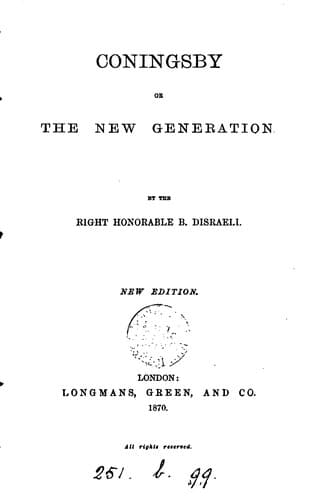
Coningsby; Or, The New GenerationDisraeli, Benjamin, Earl of Beaconsfield
General
Coningsby; Or, The New Generation
Disraeli, Benjamin, Earl of Beaconsfield
Great Britain -- Fiction; Political fiction; Politicians -- Fiction
Produced by Anne Soulard, Tiffany Vergon, and the Online
Distributed Proofreading Team
CONINGSBY
OR THE NEW GENERATION
By Benjamin Disraeli
Earl Of Beaconsfield
PUBLISHERS’ NOTE
As a novelist, Benjamin Disraeli belongs to the early part of the
nineteenth century. “Vivian Grey” (1826-27) and “Sybil” (1845) mark
the beginning and the end of his truly creative period; for the two
productions of his latest years, “Lothair” (1870) and “Endymion” (1880),
add nothing to the characteristics of his earlier volumes except the
changes of feeling and power which accompany old age. His period, thus,
is that of Bulwer, Dickens, and Thackeray, and of the later years of Sir
Walter Scott--a fact which his prominence as a statesman during the last
decade of his life, as well as the vogue of “Lothair” and “Endymion,”
has tended to obscure. His style, his material, and his views of English
character and life all date from that earlier time. He was born in 1804
and died in 1881.
“Coningsby; or, The New Generation,” published in 1844, is the best
of his novels, not as a story, but as a study of men, manners, and
principles. The plot is slight--little better than a device for
stringing together sketches of character and statements of political and
economic opinions; but these are always interesting and often brilliant.
The motive which underlies the book is political. It is, in brief, an
attempt to show that the political salvation of England was to be sought
in its aristocracy, but that this aristocracy was morally weak and
socially ineffective, and that it must mend its ways before its duty to
the state could be fulfilled. Interest in this aspect of the book has,
of course, to a large extent passed away with the political conditions
which it reflected. As a picture of aristocratic life in England in
the first part of the nineteenth century it has, however, enduring
significance and charm. Disraeli does not rank with the great writers
of English realistic fiction, but in this special field none of them
has surpassed him. From this point of view, accordingly, “Coningsby” is
appropriately included in this series.
TO HENRY HOPE
It is not because this work was conceived and partly executed amid the
glades and galleries of the DEEPDENE that I have inscribed it with your
name. Nor merely because I was desirous to avail myself of the most
graceful privilege of an author, and dedicate my work to the friend
whose talents I have always appreciated, and whose virtues I have ever
admired.
But because in these pages I have endeavoured to picture something of
that development of the new and, as I believe, better mind of England,
that has often been the subject of our converse and speculation.
In this volume you will find many a thought illustrated and many a
principle attempted to be established that we have often together
partially discussed and canvassed.
Public-domain text, read in full here on John Shaqi.
Reviews
Reviews
No reviews yet
Be the first to share your thoughts on this work.
Join the Discussion
Join the discussion
Sign in to leave a comment or review.
Sign InorCreate an account