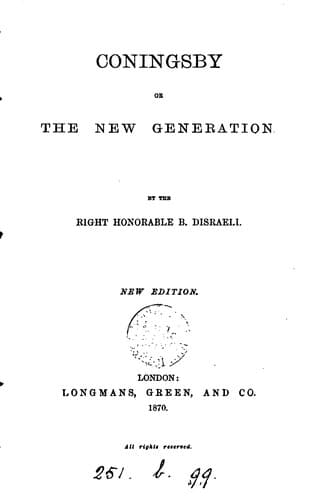
Coningsby; Or, The New GenerationDisraeli, Benjamin, Earl of Beaconsfield
General
Coningsby; Or, The New Generation
Disraeli, Benjamin, Earl of Beaconsfield
Great Britain -- Fiction; Political fiction; Politicians -- Fiction
Coningsby had too much tact to be entrapped into a long story. He
already regretted that he had been betrayed into any allusion to the
stranger. He had a wild, fanciful notion, that their meeting ought to
have been preserved as a sacred secret. But he had been impelled to
refer to it in the first instance by the chance observation of Lady
Everingham; and he had pursued his remark from the hope that the
conversation might have led to the discovery of the unknown. When he
found that his inquiry in this respect was unsuccessful, he was willing
to turn the conversation. In reply to the Duchess, then, he generally
described the talk of the stranger as full of lively anecdote and
epigrammatic views of life; and gave them, for example, a saying of an
illustrious foreign Prince, which was quite new and pointed, and which
Coningsby told well. This led to a new train of discourse. The Duke also
knew this illustrious foreign Prince, and told another story of him; and
Lord Everingham had played whist with this illustrious foreign Prince
often at the Travellers’, and this led to a third story; none of them
too long. Then Lady Everingham came in again, and sparkled agreeably.
She, indeed, sustained throughout dinner the principal weight of the
conversation; but, as she asked questions of everybody, all seemed to
contribute. Even the voice of Mr. Lyle, who was rather bashful, was
occasionally heard in reply. Coningsby, who had at first unintentionally
taken a more leading part than he aspired to, would have retired
into the background for the rest of the dinner, but Lady Everingham
continually signalled him out for her questions, and as she sat opposite
to him, he seemed the person to whom they were principally addressed.
At length the ladies rose to retire. A very great personage in a
foreign, but not remote country, once mentioned to the writer of these
pages, that he ascribed the superiority of the English in political
life, in their conduct of public business and practical views of
affairs, in a great measure to ‘that little half-hour’ that separates,
after dinner, the dark from the fair sex. The writer humbly submitted,
that if the period of disjunction were strictly limited to a ‘little
half-hour,’ its salutary consequences for both sexes need not be
disputed, but that in England the ‘little half-hour’ was too apt
to swell into a term of far more awful character and duration. Lady
Everingham was a disciple of the ‘very little half-hour’ school; for, as
she gaily followed her mother, she said to Coningsby, whose gracious lot
it was to usher them from the apartment:
‘Pray do not be too long at the Board of Guardians to-day.’
These were prophetic words; for no sooner were they all again seated,
than the Duke, filling his glass and pushing the claret to Coningsby,
observed,
‘I suppose Lord Monmouth does not trouble himself much about the New
Poor Law?’
Public-domain text, read in full here on John Shaqi.
Reviews
Reviews
No reviews yet
Be the first to share your thoughts on this work.
Elsewhere in the archive
Join the Discussion
Join the discussion
Sign in to leave a comment or review.
Sign InorCreate an account