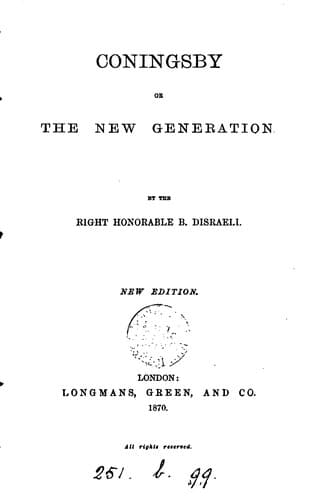
Coningsby; Or, The New GenerationDisraeli, Benjamin, Earl of Beaconsfield
General
Coningsby; Or, The New Generation
Disraeli, Benjamin, Earl of Beaconsfield
Great Britain -- Fiction; Political fiction; Politicians -- Fiction
‘Hardly,’ said Coningsby. ‘My grandfather’s frequent absence from
England, which his health, I believe, renders quite necessary, deprives
him of the advantage of personal observation on a subject, than which I
can myself conceive none more deeply interesting.’
‘I am glad to hear you say so,’ said the Duke, ‘and it does you great
credit, and Henry too, whose attention, I observe, is directed very much
to these subjects. In my time, the young men did not think so much of
such things, and we suffer consequently. By the bye, Everingham,
you, who are a Chairman of a Board of Guardians, can give me some
information. Supposing a case of out-door relief--’
‘I could not suppose anything so absurd,’ said the son-in-law.
‘Well,’ rejoined the Duke, ‘I know your views on that subject, and it
certainly is a question on which there is a good deal to be said. But
would you under any circumstances give relief out of the Union, even if
the parish were to save a considerable sum?’
‘I wish I knew the Union where such a system was followed,’ said Lord
Everingham; and his Grace seemed to tremble under his son-in-law’s
glance.
The Duke had a good heart, and not a bad head. If he had not made in
his youth so many Latin and English verses, he might have acquired
considerable information, for he had a natural love of letters, though
his pack were the pride of England, his barrel seldom missed, and his
fortune on the turf, where he never betted, was a proverb. He was good,
and he wished to do good; but his views were confused from want of
knowledge, and his conduct often inconsistent because a sense of duty
made him immediately active; and he often acquired in the consequent
experience a conviction exactly contrary to that which had prompted his
activity.
His Grace had been a great patron and a zealous administrator of the New
Poor Law. He had been persuaded that it would elevate the condition of
the labouring class. His son-in-law, Lord Everingham, who was a Whig,
and a clearheaded, cold-blooded man, looked upon the New Poor Law as
another Magna Charta. Lord Everingham was completely master of the
subject. He was himself the Chairman of one of the most considerable
Unions of the kingdom. The Duke, if he ever had a misgiving, had no
chance in argument with his son-in-law. Lord Everingham overwhelmed
him with quotations from Commissioners’ rules and Sub-commissioners’
reports, statistical tables, and references to dietaries. Sometimes with
a strong case, the Duke struggled to make a fight; but Lord Everingham,
when he was at fault for a reply, which was very rare, upbraided his
father-in-law with the abuses of the old system, and frightened him with
visions of rates exceeding rentals.
Public-domain text, read in full here on John Shaqi.
Reviews
Reviews
No reviews yet
Be the first to share your thoughts on this work.
Elsewhere in the archive
Join the Discussion
Join the discussion
Sign in to leave a comment or review.
Sign InorCreate an account