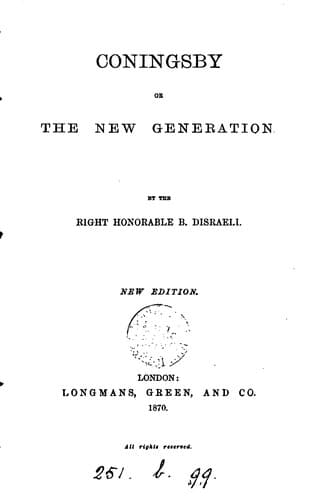
Coningsby; Or, The New GenerationDisraeli, Benjamin, Earl of Beaconsfield
General
Coningsby; Or, The New Generation
Disraeli, Benjamin, Earl of Beaconsfield
Great Britain -- Fiction; Political fiction; Politicians -- Fiction
Lady Everingham was not a celebrated beauty, but she was something
infinitely more delightful, a captivating woman. There were combined,
in her, qualities not commonly met together, great vivacity of mind with
great grace of manner. Her words sparkled and her movements charmed.
There was, indeed, in all she said and did, that congruity that
indicates a complete and harmonious organisation. It was the same just
proportion which characterised her form: a shape slight and undulating
with grace; the most beautifully shaped ear; a small, soft hand; a foot
that would have fitted the glass slipper; and which, by the bye, she
lost no opportunity of displaying; and she was right, for it was a
model.
Then there was music. Lady Theresa sang like a seraph: a rich voice, a
grand style. And her sister could support her with grace and sweetness.
And they did not sing too much. The Duke took up a review, and looked
at Rigby’s last slashing article. The country seemed ruined, but it
appeared that the Whigs were still worse off than the Tories. The
assassins had committed suicide. This poetical justice is pleasing. Lord
Everingham, lounging in an easy chair, perused with great satisfaction
his _Morning Chronicle_, which contained a cutting reply to Mr. Rigby’s
article, not quite so ‘slashing’ as the Right Honourable scribe’s
manifesto, but with some searching mockery, that became the subject and
the subject-monger.
Mr. Lyle seated himself by the Duchess, and encouraged by her amenity,
and speaking in whispers, became animated and agreeable, occasionally
patting the lap-dog. Coningsby stood by the singers, or talked with
them when the music had ceased: and Henry Sydney looked over a volume
of Strutt’s _Sports and Pastimes_, occasionally, without taking his eyes
off the volume, calling the attention of his friends to his discoveries.
Mr. Lyle rose to depart, for he had some miles to return; he came
forward with some hesitation, to hope that Coningsby would visit his
bloodhounds, which Lord Henry had told him Coningsby had expressed
a wish to do. Lady Everingham remarked that she had not been at St.
Genevieve since she was a girl, and it appeared Lady Theresa had never
visited it. Lady Everingham proposed that they should all ride over
on the morrow, and she appealed to her husband for his approbation,
instantly given, for though she loved admiration, and he apparently was
an iceberg, they were really devoted to each other. Then there was a
consultation as to their arrangements. The Duchess would drive over in
her pony chair with Theresa. The Duke, as usual, had affairs that
would occupy him. The rest were to ride. It was a happy suggestion, all
anticipated pleasure; and the evening terminated with the prospect of
what Lady Everingham called an adventure.
Public-domain text, read in full here on John Shaqi.
Reviews
Reviews
No reviews yet
Be the first to share your thoughts on this work.
Elsewhere in the archive
Join the Discussion
Join the discussion
Sign in to leave a comment or review.
Sign InorCreate an account