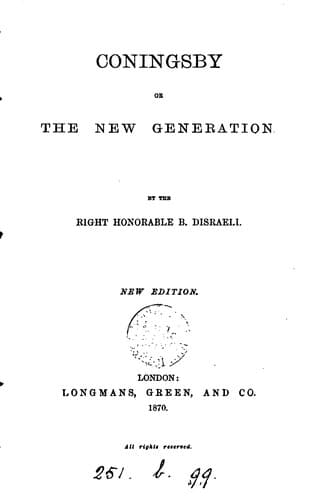
Coningsby; Or, The New GenerationDisraeli, Benjamin, Earl of Beaconsfield
General
Coningsby; Or, The New Generation
Disraeli, Benjamin, Earl of Beaconsfield
Great Britain -- Fiction; Political fiction; Politicians -- Fiction
‘But what do you mean by the labouring classes, Everingham?’ asked Lord
Henry. ‘Lawyers are a labouring class, for instance, and by the bye
sufficiently provided with work. But would you approve of Westminster
Hall being denuded of all its ceremonies?’
‘And the long vacation being abolished?’ added Coningsby.
‘Theresa brings me terrible accounts of the sufferings of the poor about
us,’ said the Duke, shaking his head.
‘Women think everything to be suffering!’ said Lord Everingham.
‘How do you find them about you, Mr. Lyle?’ continued the Duke.
‘I have revived the monastic customs at St. Genevieve,’ said the young
man, blushing. ‘There is an almsgiving twice a-week.’
‘I am sure I wish I could see the labouring classes happy,’ said the
Duke.
‘Oh! pray do not use, my dear father, that phrase, the labouring
classes!’ said Lord Henry. ‘What do you think, Coningsby, the other day
we had a meeting in this neighbourhood to vote an agricultural petition
that was to comprise all classes. I went with my father, and I was
made chairman of the committee to draw up the petition. Of course, I
described it as the petition of the nobility, clergy, gentry, yeomanry,
and peasantry of the county of ----; and, could you believe it,
they struck out _peasantry_ as a word no longer used, and inserted
_labourers_.’
‘What can it signify,’ said Lord Everingham, ‘whether a man be called a
labourer or a peasant?’
‘And what can it signify,’ said his brother-in-law, ‘whether a man be
called Mr. Howard or Lord Everingham?’
They were the most affectionate family under this roof of Beaumanoir,
and of all members of it, Lord Henry the sweetest tempered, and yet it
was astonishing what sharp skirmishes every day arose between him and
his brother-in-law, during that ‘little half-hour’ that forms so happily
the political character of the nation. The Duke, who from experience
felt that a guerilla movement was impending, asked his guests whether
they would take any more claret; and on their signifying their dissent,
moved an adjournment to the ladies.
They joined the ladies in the music-room. Coningsby, not experienced
in feminine society, and who found a little difficulty from want
of practice in maintaining conversation, though he was desirous
of succeeding, was delighted with Lady Everingham, who, instead of
requiring to be amused, amused him; and suggested so many subjects,
and glanced at so many topics, that there never was that cold, awkward
pause, so common with sullen spirits and barren brains. Lady Everingham
thoroughly understood the art of conversation, which, indeed, consists
of the exercise of two fine qualities. You must originate, and you must
sympathise; you must possess at the same time the habit of communicating
and the habit of listening. The union is rather rare, but irresistible.
Public-domain text, read in full here on John Shaqi.
Reviews
Reviews
No reviews yet
Be the first to share your thoughts on this work.
Elsewhere in the archive
Join the Discussion
Join the discussion
Sign in to leave a comment or review.
Sign InorCreate an account