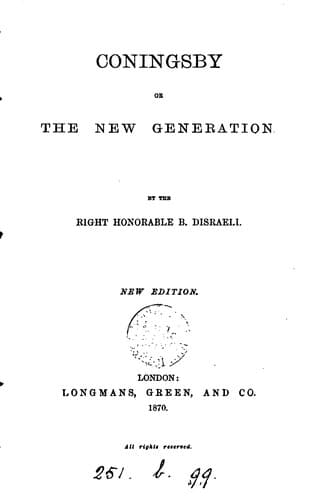
Coningsby; Or, The New GenerationDisraeli, Benjamin, Earl of Beaconsfield
General
Coningsby; Or, The New Generation
Disraeli, Benjamin, Earl of Beaconsfield
Great Britain -- Fiction; Political fiction; Politicians -- Fiction
‘My visit to Manchester, which led to this, was quite accidental,’ said
Coningsby. ‘I am bound for the other division of the county, to pay a
visit to my grandfather, Lord Monmouth; but an irresistible desire came
over me during my journey to view this famous district of industry. It
is some days since I ought to have found myself at Coningsby, and this
is the reason why I am so pressed.’
A cloud passed over the countenance of Millbank as the name of Lord
Monmouth was mentioned, but he said nothing. Turning towards Coningsby,
with an air of kindness:
‘At least,’ said he, ‘let not Oswald hear that you did not taste our
salt. Pray dine with me to-day; there is yet an hour to dinner; and
as you have seen the factory, suppose we stroll together through the
village.’
CHAPTER IV.
The village clock struck five as Mr. Millbank and his guest entered the
gardens of his mansion. Coningsby lingered a moment to admire the beauty
and gay profusion of the flowers.
‘Your situation,’ said Coningsby, looking up the green and silent
valley, ‘is absolutely poetic.’
‘I try sometimes to fancy,’ said Mr. Millbank, with a rather fierce
smile, ‘that I am in the New World.’
They entered the house; a capacious and classic hall, at the end a
staircase in the Italian fashion. As they approached it, the sweetest
and the clearest voice exclaimed from above, ‘Papa! papa!’ and instantly
a young girl came bounding down the stairs, but suddenly seeing a
stranger with her father she stopped upon the landing-place, and was
evidently on the point of as rapidly retreating as she had advanced,
when Mr. Millbank waved his hand to her and begged her to descend. She
came down slowly; as she approached them her father said, ‘A friend you
have often heard of, Edith: this is Mr. Coningsby.’
She started; blushed very much; and then, with a trembling and uncertain
gait, advanced, put forth her hand with a wild unstudied grace, and said
in a tone of sensibility, ‘How often have we all wished to see and to
thank you!’
This daughter of his host was of tender years; apparently she could
scarcely have counted sixteen summers. She was delicate and fragile, but
as she raised her still blushing visage to her father’s guest, Coningsby
felt that he had never beheld a countenance of such striking and such
peculiar beauty.
‘My only daughter, Mr. Coningsby, Edith; a Saxon name, for she is the
daughter of a Saxon.’
But the beauty of the countenance was not the beauty of the Saxons. It
was a radiant face, one of those that seem to have been touched in
their cradle by a sunbeam, and to have retained all their brilliancy and
suffused and mantling lustre. One marks sometimes such faces, diaphanous
with delicate splendour, in the southern regions of France. Her eye,
too, was the rare eye of Aquitaine; soft and long, with lashes drooping
over the cheek, dark as her clustering ringlets.
They entered the drawing-room.
Public-domain text, read in full here on John Shaqi.
Reviews
Reviews
No reviews yet
Be the first to share your thoughts on this work.
Elsewhere in the archive
Join the Discussion
Join the discussion
Sign in to leave a comment or review.
Sign InorCreate an account