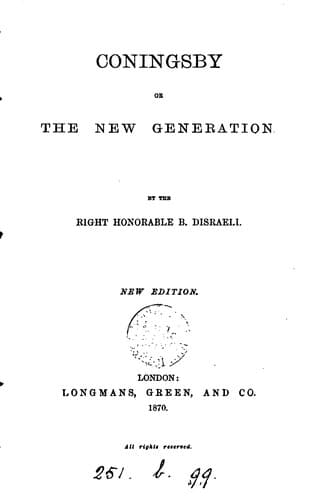
Coningsby; Or, The New GenerationDisraeli, Benjamin, Earl of Beaconsfield
General
Coningsby; Or, The New Generation
Disraeli, Benjamin, Earl of Beaconsfield
Great Britain -- Fiction; Political fiction; Politicians -- Fiction
‘Not to me,’ said Mr. Millbank. ‘I am sanguine; I am the Disciple of
Progress. But I have cause for my faith. I have witnessed advance. My
father has often told me that in his early days the displeasure of
a peer of England was like a sentence of death to a man. Why it was
esteemed a great concession to public opinion, so late as the reign of
George II., that Lord Ferrars should be executed for murder. The king of
a new dynasty, who wished to be popular with the people, insisted on
it, and even then he was hanged with a silken cord. At any rate we
may defend ourselves now,’ continued Mr. Millbank, ‘and, perhaps, do
something more. I defy any peer to crush me, though there is one who
would be very glad to do it. No more of that; I am very happy to see you
at Millbank, very happy to make your acquaintance,’ he continued, with
some emotion, ‘and not merely because you are my son’s friend and more
than friend.’
The walls of the dining-room were covered with pictures of great merit,
all of the modern English school. Mr. Millbank understood no other, he
was wont to say! and he found that many of his friends who did, bought
a great many pleasing pictures that were copies, and many originals that
were very displeasing. He loved a fine free landscape by Lee, that gave
him the broad plains, the green lanes, and running streams of his own
land; a group of animals by Landseer, as full of speech and sentiment as
if they were designed by Aesop; above all, he delighted in the household
humour and homely pathos of Wilkie. And if a higher tone of imagination
pleased him, he could gratify it without difficulty among his favourite
masters. He possessed some specimens of Etty worthy of Venice when
it was alive; he could muse amid the twilight ruins of ancient cities
raised by the magic pencil of Danby, or accompany a group of fair
Neapolitans to a festival by the genial aid of Uwins.
Opposite Coningsby was a portrait, which had greatly attracted his
attention during the whole dinner. It represented a woman, young and of
a rare beauty. The costume was of that classical character prevalent in
this country before the general peace; a blue ribbon bound together as
a fillet her clustering chestnut curls. The face was looking out of the
canvas, and Coningsby never raised his eyes without catching its glance
of blended vivacity and tenderness.
There are moments when our sensibility is affected by circumstances of
a trivial character. It seems a fantastic emotion, but the gaze of this
picture disturbed the serenity of Coningsby. He endeavoured sometimes to
avoid looking at it, but it irresistibly attracted him. More than once
during dinner he longed to inquire whom it represented; but it is a
delicate subject to ask questions about portraits, and he refrained.
Still, when he was rising to leave the room, the impulse was
irresistible. He said to Mr. Millbank, ‘By whom is that portrait, sir?’
Public-domain text, read in full here on John Shaqi.
Reviews
Reviews
No reviews yet
Be the first to share your thoughts on this work.
Elsewhere in the archive
Join the Discussion
Join the discussion
Sign in to leave a comment or review.
Sign InorCreate an account