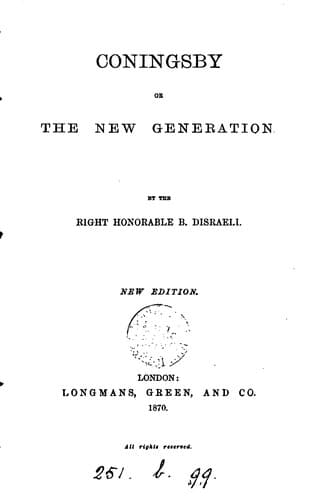
Coningsby; Or, The New GenerationDisraeli, Benjamin, Earl of Beaconsfield
General
Coningsby; Or, The New Generation
Disraeli, Benjamin, Earl of Beaconsfield
Great Britain -- Fiction; Political fiction; Politicians -- Fiction
The countenance of Millbank became disturbed; it was not an expression
of tender reminiscence that fell upon his features. On the contrary, the
expression was agitated, almost angry.
‘Oh! that is by a country artist,’ he said,’ of whom you never heard,’
and moved away.
They found Miss Millbank in the drawing-room; she was sitting at a round
table covered with working materials, apparently dressing a doll.
‘Nay,’ thought Coningsby, ‘she must be too old for that.’
He addressed her, and seated himself by her side. There were several
dolls on the table, but he discovered, on examination, that they were
pincushions; and elicited, with some difficulty, that they were making
for a fancy fair about to be held in aid of that excellent institution,
the Manchester Athenaeum. Then the father came up and said,
‘My child, let us have some tea;’ and she rose and seated herself at the
tea-table. Coningsby also quitted his seat, and surveyed the apartment.
There were several musical instruments; among others, he observed a
guitar; not such an instrument as one buys in a music shop, but such an
one as tinkles at Seville, a genuine Spanish guitar. Coningsby repaired
to the tea-table.
‘I am glad that you are fond of music, Miss Millbank.’
A blush and a bow.
‘I hope after tea you will be so kind as to touch the guitar.’
Signals of great distress.
‘Were you ever at Birmingham?’
‘Yes:’ a sigh.
‘What a splendid music-hall! They should build one at Manchester.’
‘They ought,’ in a whisper.
The tea-tray was removed; Coningsby was conversing with Mr. Millbank,
who was asking him questions about his son; what he thought of Oxford;
what he thought of Oriel; should himself have preferred Cambridge; but
had consulted a friend, an Oriel man, who had a great opinion of Oriel;
and Oswald’s name had been entered some years back. He rather regretted
it now; but the thing was done. Coningsby, remembering the promise of
the guitar, turned round to claim its fulfilment, but the singer
had made her escape. Time elapsed, and no Miss Millbank reappeared.
Coningsby looked at his watch; he had to go three miles to the train,
which started, as his friend of the previous night would phrase it, at
9.45.
‘I should be happy if you remained with us,’ said Mr. Millbank; ‘but as
you say it is out of your power, in this age of punctual travelling
a host is bound to speed the parting guest. The carriage is ready for
you.’
‘Farewell, then, sir. You must make my adieux to Miss Millbank, and
accept my thanks for your great kindness.’
‘Farewell, Mr. Coningsby,’ said his host, taking his hand, which he
retained for a moment, as if he would say more. Then leaving it, he
repeated with a somewhat wandering air, and in a voice of emotion,
‘Farewell, farewell, Mr. Coningsby.’
CHAPTER V.
Public-domain text, read in full here on John Shaqi.
Reviews
Reviews
No reviews yet
Be the first to share your thoughts on this work.
Elsewhere in the archive
Join the Discussion
Join the discussion
Sign in to leave a comment or review.
Sign InorCreate an account