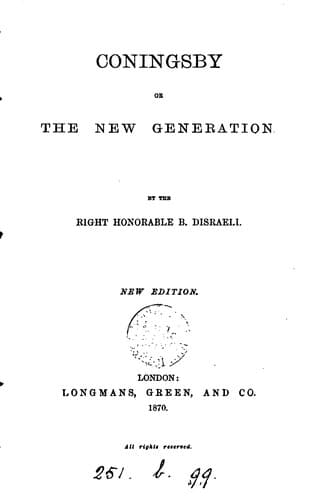
Coningsby; Or, The New GenerationDisraeli, Benjamin, Earl of Beaconsfield
General
Coningsby; Or, The New Generation
Disraeli, Benjamin, Earl of Beaconsfield
Great Britain -- Fiction; Political fiction; Politicians -- Fiction
Towards the end of the session of 1836, the hopes of the Conservative
party were again in the ascendant. The Tadpoles and the Tapers had
infused such enthusiasm into all the country attorneys, who, in their
turn, had so bedeviled the registration, that it was whispered in the
utmost confidence, but as a flagrant truth, that Reaction was at length
‘a great fact.’ All that was required was the opportunity; but as the
existing parliament was not two years old, and the government had an
excellent working majority, it seemed that the occasion could scarcely
be furnished. Under these circumstances, the backstairs politicians,
not content with having by their premature movements already seriously
damaged the career of their leader, to whom in public they pretended to
be devoted, began weaving again their old intrigues about the court, and
not without effect.
It was said that the royal ear lent itself with no marked repugnance to
suggestions which might rid the sovereign of ministers, who, after all,
were the ministers not of his choice, but of his necessity. But William
IV., after two failures in a similar attempt, after his respective
embarrassing interviews with Lord Grey and Lord Melbourne, on their
return to office in 1832 and 1835, was resolved never to make another
move unless it were a checkmate. The king, therefore, listened and
smiled, and loved to talk to his favourites of his private feelings and
secret hopes; the first outraged, the second cherished; and a little of
these revelations of royalty was distilled to great personages, who
in their turn spoke hypothetically to their hangers-on of royal
dispositions, and possible contingencies, while the hangers-on and
go-betweens, in their turn, looked more than they expressed; took
county members by the button into a corner, and advised, as friends, the
representatives of boroughs to look sharply after the next registration.
Lord Monmouth, who was never greater than in adversity, and whose
favourite excitement was to aim at the impossible, had never been more
resolved on a Dukedom than when the Reform Act deprived him of the
twelve votes which he had accumulated to attain that object. While
all his companions in discomfiture were bewailing their irretrievable
overthrow, Lord Monmouth became almost a convert to the measure, which
had furnished his devising and daring mind, palled with prosperity, and
satiated with a life of success, with an object, and the stimulating
enjoyment of a difficulty.
Public-domain text, read in full here on John Shaqi.
Reviews
Reviews
No reviews yet
Be the first to share your thoughts on this work.
Elsewhere in the archive
Join the Discussion
Join the discussion
Sign in to leave a comment or review.
Sign InorCreate an account