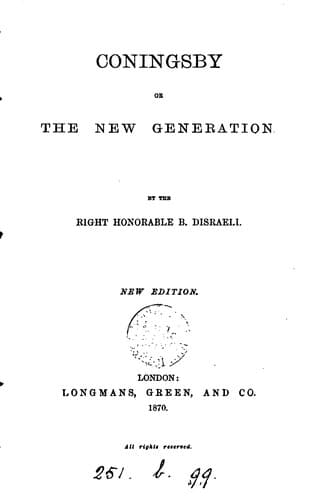
Coningsby; Or, The New GenerationDisraeli, Benjamin, Earl of Beaconsfield
General
Coningsby; Or, The New Generation
Disraeli, Benjamin, Earl of Beaconsfield
Great Britain -- Fiction; Political fiction; Politicians -- Fiction
when the proper time arrived, a Conservative candidate would certainly
have the honour of addressing the electors. No name mentioned, but it
was not concealed that he was to be of no ordinary calibre; a tried man,
a distinguished individual, who had already fought the battle of the
constitution, and served his country in eminent posts; honoured by
the nation, favoured by his sovereign. These important and encouraging
intimations were ably diffused in the columns of the Conservative
journal, and in a style which, from its high tone, evidently
indicated no ordinary source and no common pen. Indeed, there appeared
occasionally in this paper, articles written with such unusual vigour,
that the proprietors of the Liberal journal almost felt the necessity
of getting some eminent hand down from town to compete with them. It was
impossible that they could emanate from the rival Editor. They knew well
the length of their brother’s tether. Had they been more versant in the
periodical literature of the day, they might in this ‘slashing’ style
have caught perhaps a glimpse of the future candidate for their borough,
the Right Honourable Nicholas Rigby.
Lord Monmouth, though he had been absent from England since 1832, had
obtained from his vigilant correspondent a current knowledge of all that
had occurred in the interval: all the hopes, fears, plans, prospects,
manoeuvres, and machinations; their rise and fall; how some had bloomed,
others were blighted; not a shade of reaction that was not represented
to him; not the possibility of an adhesion that was not duly reported;
he could calculate at Naples at any time, within ten, the result of a
dissolution. The season of the year had prevented him crossing the Alps
in 1834, and after the general election he was too shrewd a practiser
in the political world to be deceived as to the ultimate result. Lord
Eskdale, in whose judgment he had more confidence than in that of any
individual, had told him from the first that the pear was not ripe;
Rigby, who always hedged against his interest by the fulfilment of his
prophecy of irremediable discomfiture, was never very sanguine. Indeed,
the whole affair was always considered premature by the good judges;
and a long time elapsed before Tadpole and Taper recovered their secret
influence, or resumed their ostentatious loquacity, or their silent
insolence.
Public-domain text, read in full here on John Shaqi.
Reviews
Reviews
No reviews yet
Be the first to share your thoughts on this work.
Elsewhere in the archive
Join the Discussion
Join the discussion
Sign in to leave a comment or review.
Sign InorCreate an account