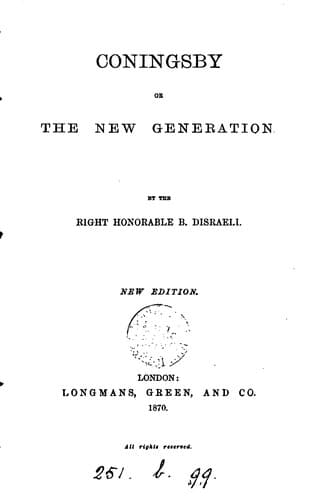
Coningsby; Or, The New GenerationDisraeli, Benjamin, Earl of Beaconsfield
General
Coningsby; Or, The New Generation
Disraeli, Benjamin, Earl of Beaconsfield
Great Britain -- Fiction; Political fiction; Politicians -- Fiction
The pear, however, was now ripe. Even Lord Eskdale wrote that after
the forthcoming registration a bet was safe, and Lord Monmouth had the
satisfaction of drawing the Whig Minister at Naples into a cool thousand
on the event. Soon after this he returned to England, and determined
to pay a visit to Coningsby Castle, feast the county, patronise the
borough, diffuse that confidence in the party which his presence never
failed to do; so great and so just was the reliance in his unerring
powers of calculation and his intrepid pluck. Notwithstanding Schedule
A, the prestige of his power had not sensibly diminished, for his
essential resources were vast, and his intellect always made the most of
his influence.
True, however, to his organisation, Lord Monmouth, even to save his
party and gain his dukedom, must not be bored. He, therefore, filled his
castle with the most agreeable people from London, and even secured for
their diversion a little troop of French comedians. Thus supported, he
received his neighbours with all the splendour befitting his immense
wealth and great position, and with one charm which even immense wealth
and great position cannot command, the most perfect manner in the world.
Indeed, Lord Monmouth was one of the most finished gentlemen that
ever lived; and as he was good-natured, and for a selfish man even
good-humoured, there was rarely a cloud of caprice or ill-temper to
prevent his fine manners having their fair play. The country neighbours
were all fascinated; they were received with so much dignity and
dismissed with so much grace. Nobody would believe a word of the stories
against him. Had he lived all his life at Coningsby, fulfilled every
duty of a great English nobleman, benefited the county, loaded the
inhabitants with favours, he would not have been half so popular as he
found himself within a fortnight of his arrival with the worst county
reputation conceivable, and every little squire vowing that he would not
even leave his name at the Castle to show his respect.
Lord Monmouth, whose contempt for mankind was absolute; not a
fluctuating sentiment, not a mournful conviction, ebbing and flowing
with circumstances, but a fixed, profound, unalterable instinct; who
never loved any one, and never hated any one except his own children;
was diverted by his popularity, but he was also gratified by it. At
this moment it was a great element of power; he was proud that, with a
vicious character, after having treated these people with unprecedented
neglect and contumely, he should have won back their golden opinions
in a moment by the magic of manner and the splendour of wealth. His
experience proved the soundness of his philosophy.
Public-domain text, read in full here on John Shaqi.
Reviews
Reviews
No reviews yet
Be the first to share your thoughts on this work.
Elsewhere in the archive
Join the Discussion
Join the discussion
Sign in to leave a comment or review.
Sign InorCreate an account