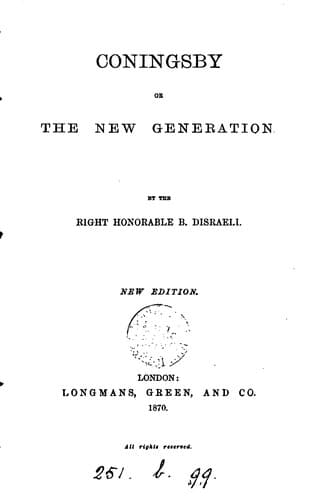
Coningsby; Or, The New GenerationDisraeli, Benjamin, Earl of Beaconsfield
General
Coningsby; Or, The New Generation
Disraeli, Benjamin, Earl of Beaconsfield
Great Britain -- Fiction; Political fiction; Politicians -- Fiction
The comedy was over, the curtain fell; the audience, much amused,
chattered brilliant criticism, and quitted the theatre to repair to
the saloon, where they were to be diverted tonight with Russian dances.
Nobody thought of the unhappy Flora; not a single message to console her
in her grief, to compliment her on what she had done, to encourage her
future. And yet it was a season for a word of kindness; so, at least,
thought one of the audience, as he lingered behind the hurrying crowd,
absorbed in their coming amusements.
Coningsby had sat very near the stage; he had observed, with great
advantage and attention, the countenance and movements of Flora from the
beginning. He was fully persuaded that her woe was genuine and profound.
He had felt his eyes moist when she wept. He recoiled from the cruelty
and the callousness that, without the slightest symptom of sympathy,
could leave a young girl who had been labouring for their amusement, and
who was suffering for her trial.
He got on the stage, ran behind the scenes, and asked for Mlle. Flora.
They pointed to a door; he requested permission to enter. Flora was
sitting at a table, with her face resting on her hands. Villebecque was
there, resting on the edge of the tall fender, and still in the dress in
which he had performed in the last piece.
‘I took the liberty,’ said Coningsby, ‘of inquiring after Mlle. Flora;’
and then advancing to her, who had raised her head, he added, ‘I am sure
my grandfather must feel much indebted to you, Mademoiselle, for making
such exertions when you were suffering under so much indisposition.’
‘This is very amiable of you, sir,’ said the young lady, looking at him
with earnestness.
‘Mademoiselle has too much sensibility,’ said Villebecque, making an
observation by way of diversion.
‘And yet that must be the soul of fine acting,’ said Coningsby; ‘I look
forward, all look forward, with great interest to the next occasion on
which you will favour us.’
‘Never!’ said La Petite, in a plaintive tone; ‘oh, I hope, never!’
‘Mademoiselle is not aware at this moment,’ said Coningsby, ‘how much
her talent is appreciated. I assure you, sir,’ he added, turning
to Villebecque, ‘I heard but one opinion, but one expression of
gratification at her feeling and her fine taste.’
‘The talent is hereditary,’ said Villebecque.
‘Indeed you have reason to say so,’ said Coningsby.
‘Pardon; I was not thinking of myself. My child reminded me so much of
another this evening. But that is nothing. I am glad you are here, sir,
to reassure Mademoiselle.’
‘I came only to congratulate her, and to lament, for our sakes as well
as her own, her indisposition.’
‘It is not indisposition,’ said La Petite, in a low tone, with her eyes
cast down.
‘Mademoiselle cannot overcome the nervousness incidental to a first
appearance,’ said Villebecque.
Public-domain text, read in full here on John Shaqi.
Reviews
Reviews
No reviews yet
Be the first to share your thoughts on this work.
Elsewhere in the archive
Join the Discussion
Join the discussion
Sign in to leave a comment or review.
Sign InorCreate an account