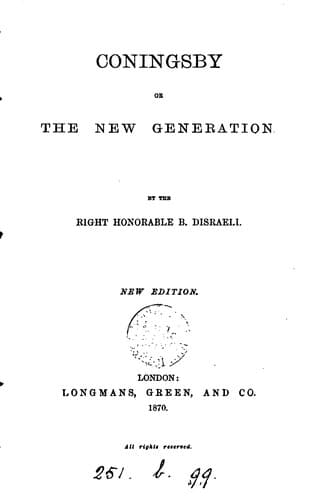
Coningsby; Or, The New GenerationDisraeli, Benjamin, Earl of Beaconsfield
General
Coningsby; Or, The New Generation
Disraeli, Benjamin, Earl of Beaconsfield
Great Britain -- Fiction; Political fiction; Politicians -- Fiction
Flora did not appear in the next scene. In the fourth and final one
of the act, she had to make a grand display. It was a love-scene, and
rather of an impassioned character; Villebecque was her suitor. He
entered first on the stage. Never had he looked so well, or performed
with more spirit. You would not have given him five-and-twenty years; he
seemed redolent of youth. His dress, too, was admirable. He had studied
the most distinguished of his audience for the occasion, and had
outdone them all. The fact is, he had been assisted a little by a great
connoisseur, a celebrated French nobleman, Count D’O----y, who had been
one of the guests. The thing was perfect; and Lord Monmouth took a pinch
of snuff, and tapped approbation on the top of his box.
Flora now re-appeared, received with renewed approbation. It did not
seem, however, that in the interval she had gained courage; she looked
agitated. She spoke, she proceeded with her part; it became impassioned.
She had to speak of her feelings; to tell the secrets of her heart; to
confess that she loved another; her emotion was exquisitely performed,
the mournful tenderness of her tones thrilling. There was, throughout
the audience, a dead silence; all were absorbed in their admiration of
the unrivalled artist; all felt a new genius had visited the stage; but
while they were fascinated by the actress, the woman was in torture. The
emotion was the disturbance of her own soul; the mournful tenderness of
her tones thrilled from the heart: suddenly she clasped her hands with
all the exhaustion of woe; an expression of agony flitted over her
countenance; and she burst into tears. Villebecque rushed forward, and
carried, rather than led, her from the stage; the audience looking at
each other, some of them suspecting that this movement was a part of the
scene.
‘She has talent,’ said Lord Monmouth to the Russian Ambassadress,
‘but wants practice. Villebecque should send her for a time to the
provinces.’
At length M. Villebecque came forward to express his deep regret
that the sudden and severe indisposition of Mlle. Flora rendered it
impossible for the company to proceed with the piece; but that the
curtain would descend to rise again for the second and last piece
announced.
All this accordingly took place. The experienced performer who acted the
heroines now came forward and disported most jocundly. The failure of
Flora had given fresh animation to her perpetual liveliness. She seemed
the very soul of elegant frolic. In the last scene she figured in male
attire; and in air, fashion, and youth, beat Villebecque out of
the field. She looked younger than Coningsby when he went up to his
grandpapa.
Public-domain text, read in full here on John Shaqi.
Reviews
Reviews
No reviews yet
Be the first to share your thoughts on this work.
Elsewhere in the archive
Join the Discussion
Join the discussion
Sign in to leave a comment or review.
Sign InorCreate an account