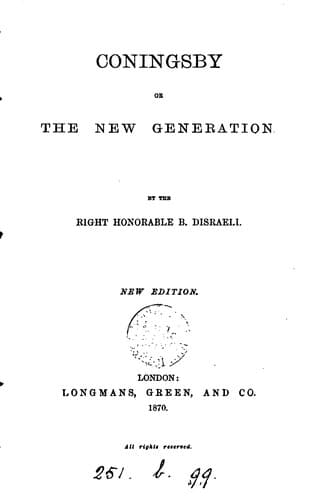
Coningsby; Or, The New GenerationDisraeli, Benjamin, Earl of Beaconsfield
General
Coningsby; Or, The New Generation
Disraeli, Benjamin, Earl of Beaconsfield
Great Britain -- Fiction; Political fiction; Politicians -- Fiction
As time flew on, there were changes of visitors, chiefly among the
single men. At the end of the first week after Coningsby’s arrival, Lord
Eskdale appeared, bringing with him Lucian Gay; and soon after followed
the Marquess of Beaumanoir and Mr. Melton. These were all heroes who,
in their way, interested the ladies, and whose advent was hailed
with general satisfaction. Even Lucretia would relax a little to Lord
Eskdale. He was one of her oldest friends, and with a simplicity of
manner which amounted almost to plainness, and with rather a cynical
nonchalance in his carriage towards men, Lord Eskdale was invariably a
favourite with women. To be sure his station was eminent; he was noble,
and very rich, and very powerful, and these are qualities which tell as
much with the softer as the harsher sex; but there are individuals with
all these qualities who are nevertheless unpopular with women. Lord
Eskdale was easy, knew the world thoroughly, had no prejudices, and,
above all, had a reputation for success. A reputation for success has as
much influence with women as a reputation for wealth has with men. Both
reputations may be, and often are, unjust; but we see persons daily make
good fortunes by them all the same. Lord Eskdale was not an impostor;
and though he might not have been so successful a man had he not been
Lord Eskdale, still, thrown over by a revolution, he would have lighted
on his legs.
The arrival of this nobleman was the occasion of giving a good turn to
poor Flora. He went immediately to see his friend Villebecque and his
troop. Indeed it was a sort of society which pleased Lord Eskdale more
than that which is deemed more refined. He was very sorry about ‘La
Petite;’ but thought that everything would come right in the long run;
and told Villebecque that he was glad to hear him well spoken of here,
especially by the Marquess, who seemed to take to him. As for Flora, he
was entirely against her attempting the stage again, at least for the
present, but as she was a good musician, he suggested to the Princess
Lucretia one night, that the subordinate aid of Flora might be of
service to her, and permit her to favour her friends with some pieces
which otherwise she must deny to them. This suggestion was successful;
Flora was introduced occasionally, soon often, to their parties in the
evening, and her performances were in every respect satisfactory. There
was nothing to excite the jealousy of Lucretia either in her style or
her person. And yet she sang well enough, and was a quiet, refined,
retiring, by no means disagreeable person. She was the companion of
Lucretia very often in the morning as well as in the illumined saloon;
for the Princess was devoted to the art in which she excelled. This
connexion on the whole contributed to the happiness of poor Flora. True
it was, in the evening she often found herself sitting or standing alone
and no one noticing her; she had no dazzling quality to attract men of
Public-domain text, read in full here on John Shaqi.
Reviews
Reviews
No reviews yet
Be the first to share your thoughts on this work.
Elsewhere in the archive
Join the Discussion
Join the discussion
Sign in to leave a comment or review.
Sign InorCreate an account