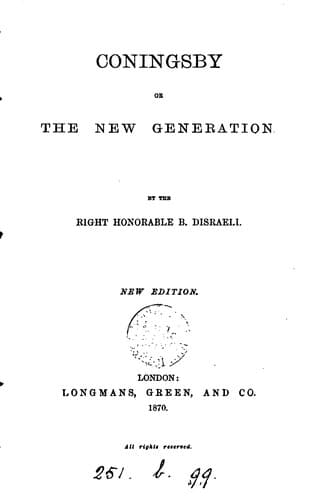
Coningsby; Or, The New GenerationDisraeli, Benjamin, Earl of Beaconsfield
General
Coningsby; Or, The New Generation
Disraeli, Benjamin, Earl of Beaconsfield
Great Britain -- Fiction; Political fiction; Politicians -- Fiction
fashion, who themselves love to worship ever the fashionable. Even
their goddesses must be _à la mode_. But Coningsby never omitted an
opportunity to show Flora some kindness under these circumstances.
He always came and talked to her, and praised her singing, and would
sometimes hand her refreshments and give her his arm if necessary. These
slight attentions coming from the grandson of Lord Monmouth were for
the world redoubled in their value, though Flora thought only of their
essential kindness; all in character with that first visit which dwelt
on the poor girl’s memory, though it had long ago escaped that of her
visitor. For in truth Coningsby had no other impulse for his conduct but
kind-heartedness.
Thus we have attempted to give some faint idea how life glided away at
the Castle the first fortnight that Coningsby passed there. Perhaps we
ought not to omit that Mrs. Guy Flouncey, to the infinite disgust of
Lady St. Julians, who had a daughter with her, successfully entrapped
the devoted attentions of the young Marquess of Beaumanoir, who was
never very backward if a lady would take trouble enough; while his
friend, Mr. Melton, whose barren homage Lady St. Julians wished
her daughter ever particularly to shun, employed all his gaiety,
good-humour, frivolity, and fashion in amusing that young lady, and with
irresistible effect. For the rest, they continued, though they had only
partridges to shoot, to pass the morning without weariness. The weather
was fine; the stud numerous; all might be mounted. The Grand-duke and
his suite, guided by Mr. Rigby, had always some objects to visit, and
railroads returned them just in time for the banquet with an appetite
which they had earned, and during which Rigby recounted their
achievements, and his own opinions.
The dinner was always firstrate; the evening never failed; music,
dancing, and the theatre offered great resources independently of the
soul-subduing sentiment harshly called flirtation, and which is the
spell of a country house. Lord Monmouth was satisfied, for he had
scarcely ever felt wearied. All that he required in life was to be
amused; perhaps that was not all he required, but it was indispensable.
Nor was it wonderful that on the present occasion he obtained his
purpose, for there were half a hundred of the brightest eyes
and quickest brains ever on the watch or the whirl to secure him
distraction. The only circumstance that annoyed him was the non-arrival
of Sidonia. Lord Monmouth could not bear to be disappointed. He could
not refrain from saying, notwithstanding all the resources and all the
exertions of his guests,
‘I cannot understand why Sidonia does not come. I wish Sidonia were
here.’
‘So do I,’ said Lord Eskdale; ‘Sidonia is the only man who tells one
anything new.’
‘We saw Sidonia at Lord Studcaster’s,’ said Lord Beaumanoir. ‘He told
Melton he was coming here.’
‘You know he has bought all Studcaster’s horses,’ said Mr. Melton.
Public-domain text, read in full here on John Shaqi.
Reviews
Reviews
No reviews yet
Be the first to share your thoughts on this work.
Elsewhere in the archive
Join the Discussion
Join the discussion
Sign in to leave a comment or review.
Sign InorCreate an account