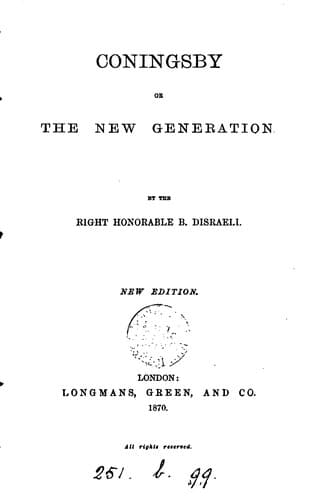
Coningsby; Or, The New GenerationDisraeli, Benjamin, Earl of Beaconsfield
General
Coningsby; Or, The New Generation
Disraeli, Benjamin, Earl of Beaconsfield
Great Britain -- Fiction; Political fiction; Politicians -- Fiction
The somewhat hard and literal character of English life suited one who
shrank from sensibility, and often took refuge in sarcasm. Its masculine
vigour and active intelligence occupied and interested his mind.
Sidonia, indeed, was exactly the character who would be welcomed in our
circles. His immense wealth, his unrivalled social knowledge, his clear
vigorous intellect, the severe simplicity of his manners, frank, but
neither claiming nor brooking familiarity, and his devotion to field
sports, which was the safety-valve of his energy, were all circumstances
and qualities which the English appreciate and admire; and it may be
fairly said of Sidonia that few men were more popular, and none less
understood.
CHAPTER XI.
At dinner, Coningsby was seated on the same side as Sidonia, and distant
from him. There had been, therefore, no mutual recognition. Another
guest had also arrived, Mr. Ormsby. He came straight from London,
full of rumours, had seen Tadpole, who, hearing he was on the wing for
Coningsby Castle, had taken him into a dark corner of a club, and
shown him his book, a safe piece of confidence, as Mr. Ormsby was very
near-sighted. It was, however, to be received as an undoubted fact, that
all was right, and somehow or other, before very long, there would be
national demonstration of the same. This arrival of Mr. Ormsby, and the
news that he bore, gave a political turn to the conversation after the
ladies had left the room.
‘Tadpole wants me to stand for Birmingham,’ said Mr. Ormsby, gravely.
‘You!’ exclaimed Lord Monmouth, and throwing himself back in his chair,
he broke into a real, hearty laugh.
‘Yes; the Conservatives mean to start two candidates; a manufacturer
they have got, and they have written up to Tadpole for a “West-end
man.”’
‘A what?’
‘A West-end man, who will make the ladies patronise their fancy
articles.’
‘The result of the Reform Bill, then,’ said Lucian Gay, ‘will be to give
Manchester a bishop, and Birmingham a dandy.’
‘I begin to believe the result will be very different from what we
expected,’ said Lord Monmouth.
Mr. Rigby shook his head and was going to prophesy, when Lord Eskdale,
who liked talk to be short, and was of opinion that Rigby should keep
his amplifications for his slashing articles, put in a brief careless
observation, which balked his inspiration.
‘Certainly,’ said Mr. Ormsby, ‘when the guns were firing over Vyvyan’s
last speech and confession, I never expected to be asked to stand for
Birmingham.’
‘Perhaps you may be called up to the other house by the title,’ said
Lucian Gay. ‘Who knows?’
‘I agree with Tadpole,’ said Mr. Ormsby, ‘that if we only stick to the
Registration the country is saved.’
‘Fortunate country!’ said Sidonia, ‘that can be saved by a good
registration!’
‘I believe, after all, that with property and pluck,’ said Lord
Monmouth, ‘Parliamentary Reform is not such a very bad thing.’
Public-domain text, read in full here on John Shaqi.
Reviews
Reviews
No reviews yet
Be the first to share your thoughts on this work.
Elsewhere in the archive
Join the Discussion
Join the discussion
Sign in to leave a comment or review.
Sign InorCreate an account