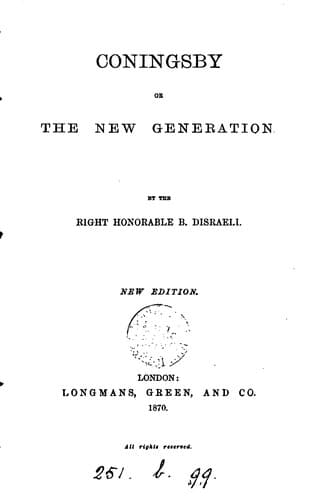
Coningsby; Or, The New GenerationDisraeli, Benjamin, Earl of Beaconsfield
General
Coningsby; Or, The New Generation
Disraeli, Benjamin, Earl of Beaconsfield
Great Britain -- Fiction; Political fiction; Politicians -- Fiction
Here several gentlemen began talking at the same time, all agreeing
with their host, and proving in their different ways, the irresistible
influence of property and pluck; property in Lord Monmouth’s mind
meaning vassals, and pluck a total disregard for public opinion. Mr. Guy
Flouncey, who wanted to get into parliament, but why nobody knew, who
had neither political abilities nor political opinions, but had some
floating idea that it would get himself and his wife to some more
balls and dinners, and who was duly ticketed for ‘a good thing’ in the
candidate list of the Tadpoles and the Tapers, was of opinion that an
immense deal might be done by properly patronising borough races. That
was his specific how to prevent revolution.
Taking advantage of a pause, Lord Monmouth said, ‘I should like to know
what you think of this question, Sidonia?’
‘I am scarcely a competent judge,’ he said, as if wishing to disclaim
any interference in the conversation, and then added, ‘but I have been
ever of opinion that revolutions are not to be evaded.’
‘Exactly my views,’ said Mr. Rigby, eagerly; ‘I say it now, I have said
it a thousand times, you may doctor the registration as you like, but
you can never get rid of Schedule A.’
‘Is there a person in this room who can now tell us the names of the
boroughs in Schedule A?’ said Sidonia.
‘I am sure I cannot, ‘said Lord Monmouth, ‘though six of them belong to
myself.’
‘But the principle,’ said Mr. Rigby; ‘they represented a principle.’
‘Nothing else, certainly,’ said Lucian Gay.
‘And what principle?’ inquired Sidonia.
‘The principle of nomination.’
‘That is a practice, not a principle,’ said Sidonia. ‘Is it a practice
that no longer exists?’
‘You think then,’ said Lord Eskdale, cutting in before Rigby, ‘that the
Reform Bill has done us no harm?’
‘It is not the Reform Bill that has shaken the aristocracy of this
country, but the means by which that Bill was carried,’ replied Sidonia.
‘Physical force?’ said Lord Eskdale.
‘Or social power?’ said Sidonia.
Upon this, Mr. Rigby, impatient at any one giving the tone in a
political discussion but himself, and chafing under the vigilance of
Lord Eskdale, which to him ever appeared only fortuitous, violently
assaulted the argument, and astonished several country gentlemen present
by its volubility. They at length listened to real eloquence. At the
end of a long appeal to Sidonia, that gentleman only bowed his head and
said, ‘Perhaps;’ and then, turning to his neighbour, inquired whether
birds were plentiful in Lancashire this season; so that Mr. Rigby was
reduced to the necessity of forming the political opinions of Mr. Guy
Flouncey.
As the gentlemen left the dining-room, Coningsby, though at some
distance, was observed by Sidonia, who stopped instantly, then advanced
to Coningsby, and extending his hand said, ‘I said we should meet again,
though I hardly expected so quickly.’
Public-domain text, read in full here on John Shaqi.
Reviews
Reviews
No reviews yet
Be the first to share your thoughts on this work.
Elsewhere in the archive
Join the Discussion
Join the discussion
Sign in to leave a comment or review.
Sign InorCreate an account