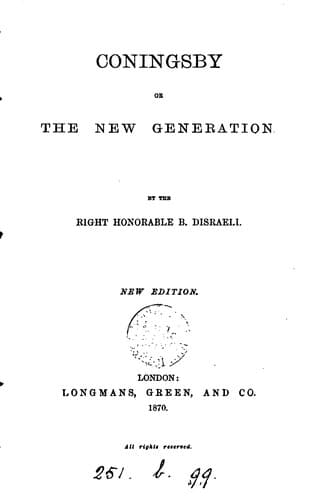
Coningsby; Or, The New GenerationDisraeli, Benjamin, Earl of Beaconsfield
General
Coningsby; Or, The New Generation
Disraeli, Benjamin, Earl of Beaconsfield
Great Britain -- Fiction; Political fiction; Politicians -- Fiction
‘You will observe one curious trait,’ said Sidonia to Coningsby, ‘in the
history of this country: the depository of power is always unpopular;
all combine against it; it always falls. Power was deposited in the
great Barons; the Church, using the King for its instrument, crushed the
great Barons. Power was deposited in the Church; the King, bribing the
Parliament, plundered the Church. Power was deposited in the King; the
Parliament, using the People, beheaded the King, expelled the King,
changed the King, and, finally, for a King substituted an administrative
officer. For one hundred and fifty years Power has been deposited in the
Parliament, and for the last sixty or seventy years it has been becoming
more and more unpopular. In 1830 it was endeavoured by a reconstruction
to regain the popular affection; but, in truth, as the Parliament then
only made itself more powerful, it has only become more odious. As we
see that the Barons, the Church, the King, have in turn devoured each
other, and that the Parliament, the last devourer, remains, it is
impossible to resist the impression that this body also is doomed to be
destroyed; and he is a sagacious statesman who may detect in what form
and in what quarter the great consumer will arise.’
‘You take, then, a dark view of our position?’
‘Troubled, not dark. I do not ascribe to political institutions that
paramount influence which it is the feeling of this age to attribute to
them. The Senate that confronted Brennus in the Forum was the same body
that registered in an after-age the ribald decrees of a Nero. Trial
by jury, for example, is looked upon by all as the Palladium of our
liberties; yet a jury, at a very recent period of our own history, the
reign of Charles II., was a tribunal as iniquitous as the Inquisition.’
And a graver expression stole over the countenance of Sidonia as he
remembered what that Inquisition had operated on his own race and his
own destiny. ‘There are families in this country,’ he continued, ‘of
both the great historical parties, that in the persecution of their
houses, the murder and proscription of some of their most illustrious
members, found judges as unjust and relentless in an open jury of their
countrymen as we did in the conclaves of Madrid and Seville.’
‘Where, then, would you look for hope?’
‘In what is more powerful than laws and institutions, and without which
the best laws and the most skilful institutions may be a dead letter,
or the very means of tyranny in the national character. It is not in
the increased feebleness of its institutions that I see the peril of
England; it is in the decline of its character as a community.’
‘And yet you could scarcely describe this as an age of corruption?’
Public-domain text, read in full here on John Shaqi.
Reviews
Reviews
No reviews yet
Be the first to share your thoughts on this work.
Elsewhere in the archive
Join the Discussion
Join the discussion
Sign in to leave a comment or review.
Sign InorCreate an account