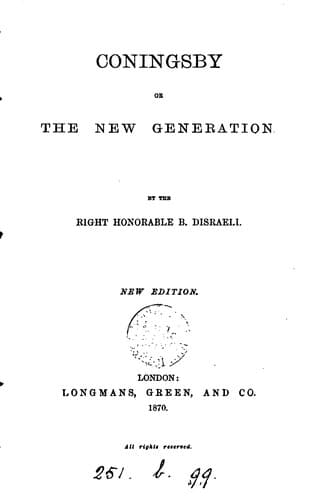
Coningsby; Or, The New GenerationDisraeli, Benjamin, Earl of Beaconsfield
General
Coningsby; Or, The New Generation
Disraeli, Benjamin, Earl of Beaconsfield
Great Britain -- Fiction; Political fiction; Politicians -- Fiction
‘Not of political corruption. But it is an age of social
disorganisation, far more dangerous in its consequences, because far
more extensive. You may have a corrupt government and a pure community;
you may have a corrupt community and a pure administration. Which would
you elect?’
Neither,’ said Coningsby; ‘I wish to see a people full of faith, and a
government full of duty.’
‘Rely upon it,’ said Sidonia, ‘that England should think more of the
community and less of the government.’
‘But tell me, what do you understand by the term national character?’
‘A character is an assemblage of qualities; the character of England
should be an assemblage of great qualities.’
‘But we cannot deny that the English have great virtues.’
‘The civilisation of a thousand years must produce great virtues; but we
are speaking of the decline of public virtue, not its existence.’
‘In what, then, do you trace that decline?’
‘In the fact that the various classes of this country are arrayed
against each other.’
‘But to what do you attribute those reciprocal hostilities?’
‘Not entirely, not even principally, to those economical causes of which
we hear so much. I look upon all such as secondary causes, which, in a
certain degree, must always exist, which obtrude themselves in troubled
times, and which at all times it is the business of wise statesmen to
watch, to regulate, to ameliorate, to modify.’
‘I am speaking to elicit truth, not to maintain opinions,’ said
Coningsby; ‘for I have none,’ he added, mournfully.
‘I think,’ said Sidonia, ‘that there is no error so vulgar as to believe
that revolutions are occasioned by economical causes. They come in,
doubtless, very often to precipitate a catastrophe; very rarely do they
occasion one. I know no period, for example, when physical comfort
was more diffused in England than in 1640. England had a moderate
population, a very improved agriculture, a rich commerce; yet she was
on the eve of the greatest and most violent changes that she has as yet
experienced.’
‘That was a religious movement.’
‘Admit it; the cause, then, was not physical. The imagination of England
rose against the government. It proves, then, that when that faculty is
astir in a nation, it will sacrifice even physical comfort to follow its
impulses.’
‘Do you think, then, there is a wild desire for extensive political
change in the country?’
Public-domain text, read in full here on John Shaqi.
Reviews
Reviews
No reviews yet
Be the first to share your thoughts on this work.
Elsewhere in the archive
Join the Discussion
Join the discussion
Sign in to leave a comment or review.
Sign InorCreate an account