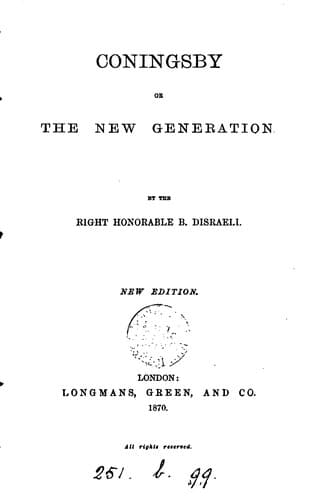
Coningsby; Or, The New GenerationDisraeli, Benjamin, Earl of Beaconsfield
General
Coningsby; Or, The New Generation
Disraeli, Benjamin, Earl of Beaconsfield
Great Britain -- Fiction; Political fiction; Politicians -- Fiction
‘Hardly that: England is perplexed at the present moment, not inventive.
That will be the next phasis in her moral state, and to that I wish
to draw your thoughts. For myself, while I ascribe little influence to
physical causes for the production of this perplexity, I am still less
of opinion that it can be removed by any new disposition of political
power. It would only aggravate the evil. That would be recurring to
the old error of supposing you can necessarily find national content in
political institutions. A political institution is a machine; the motive
power is the national character. With that it rests whether the
machine will benefit society, or destroy it. Society in this country is
perplexed, almost paralysed; in time it will move, and it will devise.
How are the elements of the nation to be again blended together? In what
spirit is that reorganisation to take place?’
‘To know that would be to know everything.’
‘At least let us free ourselves from the double ignorance of the
Platonists. Let us not be ignorant that we are ignorant.’
‘I have emancipated myself from that darkness for a long time,’ said
Coningsby. ‘Long has my mind been musing over these thoughts, but to me
all is still obscurity.’
‘In this country,’ said Sidonia, ‘since the peace, there has been an
attempt to advocate a reconstruction of society on a purely rational
basis. The principle of Utility has been powerfully developed. I speak
not with lightness of the labours of the disciples of that school. I bow
to intellect in every form: and we should be grateful to any school of
philosophers, even if we disagree with them; doubly grateful in this
country, where for so long a period our statesmen were in so pitiable an
arrear of public intelligence. There has been an attempt to reconstruct
society on a basis of material motives and calculations. It has failed.
It must ultimately have failed under any circumstances; its failure in
an ancient and densely-peopled kingdom was inevitable. How limited is
human reason, the profoundest inquirers are most conscious. We are not
indebted to the Reason of man for any of the great achievements which
are the landmarks of human action and human progress. It was not Reason
that besieged Troy; it was not Reason that sent forth the Saracen
from the Desert to conquer the world; that inspired the Crusades; that
instituted the Monastic orders; it was not Reason that produced
the Jesuits; above all, it was not Reason that created the French
Revolution. Man is only truly great when he acts from the passions;
never irresistible but when he appeals to the imagination. Even Mormon
counts more votaries than Bentham.’
‘And you think, then, that as Imagination once subdued the State,
Imagination may now save it?’
‘Man is made to adore and to obey: but if you will not command him, if
you give him nothing to worship, he will fashion his own divinities, and
find a chieftain in his own passions.’
Public-domain text, read in full here on John Shaqi.
Reviews
Reviews
No reviews yet
Be the first to share your thoughts on this work.
Elsewhere in the archive
Join the Discussion
Join the discussion
Sign in to leave a comment or review.
Sign InorCreate an account