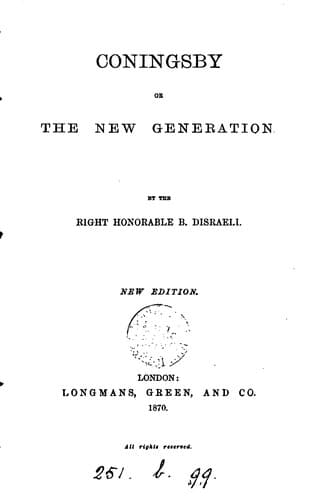
Coningsby; Or, The New GenerationDisraeli, Benjamin, Earl of Beaconsfield
General
Coningsby; Or, The New Generation
Disraeli, Benjamin, Earl of Beaconsfield
Great Britain -- Fiction; Political fiction; Politicians -- Fiction
Between Madame Colonna and Mr. Rigby there had always subsisted
considerable confidence. Now, that gentleman seemed to have achieved
fresh and greater claims to her regard. In the pleasure with which he
looked forward to her approaching alliance with his patron, he reminded
her of the readiness with which he had embraced her suggestions for the
marriage of her daughter with Coningsby. Always obliging, she was never
wearied of chanting his praises to her noble admirer, who was apparently
much gratified she should have bestowed her esteem on one of whom she
would necessarily in after-life see so much. It is seldom the lot of
husbands that their confidential friends gain the regards of their
brides.
‘I am glad you all like Rigby,’ said Lord Monmouth, ‘as you will see so
much of him.’
The remembrance of the Hellingsley failure seemed to be erased from the
memory of the Marquess. Rigby never recollected him more cordial and
confidential, and more equable in his manner. He told Rigby one day,
that he wished that Monmouth House should possess the most sumptuous
and the most fanciful boudoir in London or Paris. What a hint for Rigby!
That gentleman consulted the first artists, and gave them some hints in
return; his researches on domestic decoration ranged through all
ages; he even meditated a rapid tour to mature his inventions; but his
confidence in his native taste and genius ultimately convinced him that
this movement was unnecessary.
The summer advanced; the death of the King occurred; the dissolution
summoned Rigby to Coningsby and the borough of Darlford. His success was
marked certain in the secret books of Tadpole and Taper. A manufacturing
town, enfranchised under the Reform Act, already gained by the
Conservative cause! Here was reaction; here influence of property!
Influence of character, too; for no one was so popular as Lord Monmouth;
a most distinguished nobleman of strict Conservative principles, who,
if he carried the county and the manufacturing borough also, merited the
strawberry-leaf.
‘There will be no holding Rigby,’ said Taper; ‘I’m afraid he will be
looking for something very high.’
‘The higher the better,’ rejoined Tadpole, ‘and then he will not
interfere with us. I like your high-flyers; it is your plodders I
detest, wearing old hats and high-lows, speaking in committee, and
thinking they are men of business: d----n them!’
Rigby went down, and made some impressive speeches; at least they read
very well in some of his second-rate journals, where all the uproar
figured as loud cheering, and the interruption of a cabbage-stalk was
represented as a question from some intelligent individual in the crowd.
The fact is, Rigby bored his audience too much with history, especially
with the French Revolution, which he fancied was his ‘forte,’ so that
the people at last, whenever he made any allusion to the subject, were
almost as much terrified as if they had seen the guillotine.
Public-domain text, read in full here on John Shaqi.
Reviews
Reviews
No reviews yet
Be the first to share your thoughts on this work.
Elsewhere in the archive
Join the Discussion
Join the discussion
Sign in to leave a comment or review.
Sign InorCreate an account